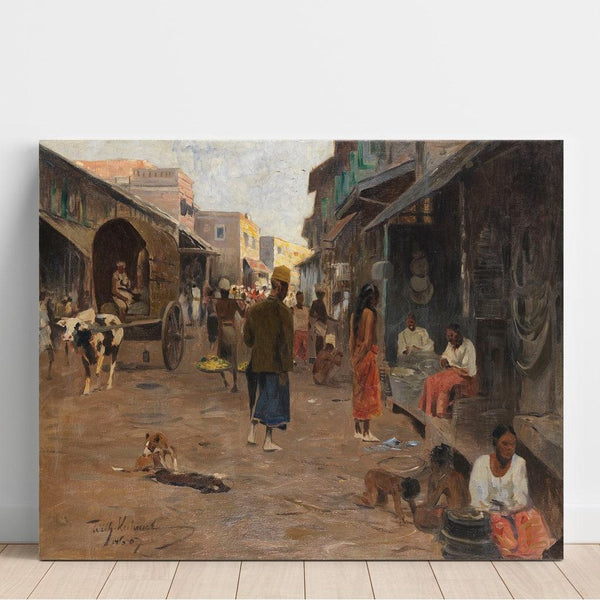
Few artists have shaped our imagination of African wildlife as powerfully as Wilhelm Kuhnert. A German wildlife painter active at the turn of the nineteenth and twentieth centuries, he devoted his career to depicting the great wild animals no longer as menagerie curiosities, but as beings captured in their natural surroundings. His lions, his elephants and his savanna scenes combine an almost scientific accuracy with genuine pictorial ambition. This article offers a sober, well-documented look at the artist's journey, his singular method and the legacy he left behind.
A journey between the Berlin studio and the African continent
Wilhelm Kuhnert was born in 1865 in Oppeln, in Silesia, then a Prussian province. Drawn to animal drawing from an early age, he trained at the Berlin Academy of Arts, where he received a solid academic education under recognised masters. This training gave him a command of drawing, anatomy and composition that would remain the foundation of all his work. Berlin, at that time, was a major artistic and scientific centre, and the young painter found himself in contact with an environment where the representation of the natural world held an important place.
What set Kuhnert apart from many of his contemporaries was his decision not to settle for the animals visible in zoos or collections. From the 1890s onward, he undertook a series of journeys to East Africa, particularly in the territories of German East Africa, corresponding largely to present-day Tanzania. These expeditions, often long and gruelling, led him into the heart of the savannas and gave him the chance to observe the great mammals directly in their environment. Over the course of his career, he would broaden his field of exploration to other regions, continually enriching his repertoire of motifs and impressions.

Fieldwork observation as a method
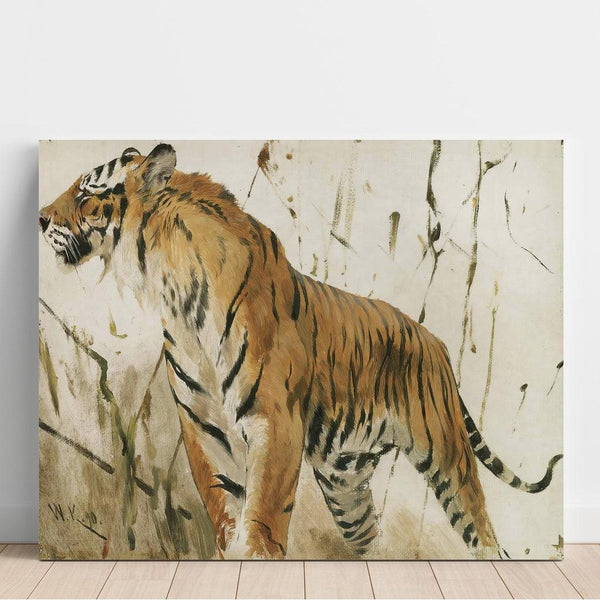
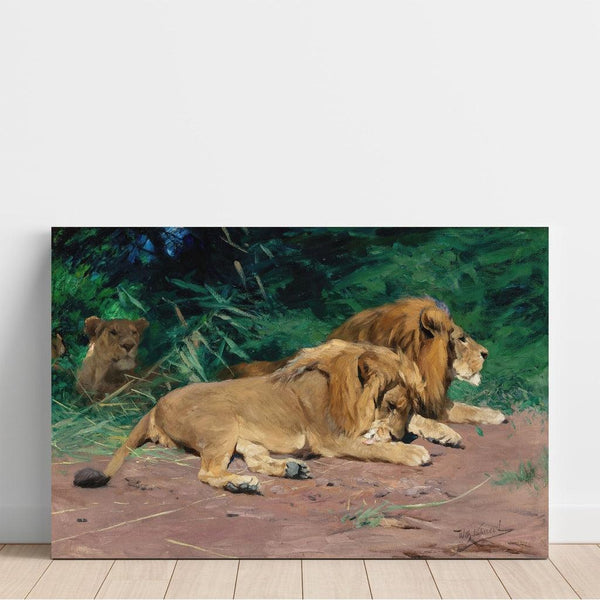
Kuhnert's approach rested on one conviction: to paint an animal accurately, you must have seen it alive. In the field, he worked through sketches and rapid studies, noting postures, proportions, the play of light on coats, the texture of a hide or the attitude of a big cat at rest. These documents taken from life formed the raw material he would later work up in the studio into larger, more polished compositions. This back and forth between direct observation and the considered work of painting gives his works their dual character, at once alive and constructed.
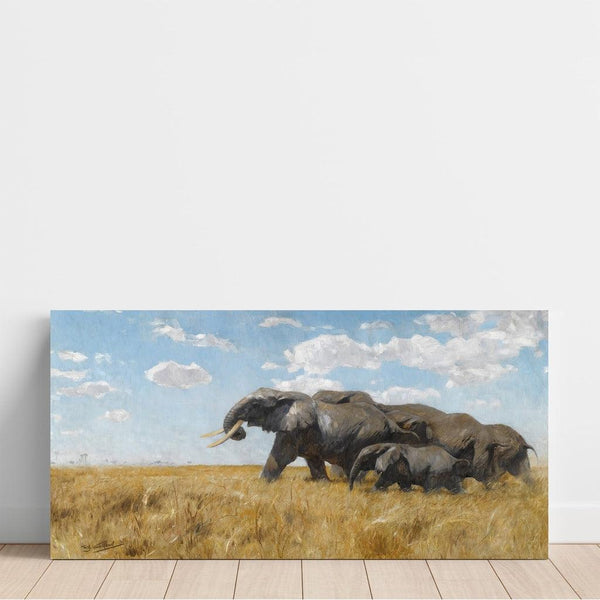
His favourite subject remained the lion, which he studied at length and which he helped to establish in the collective imagination as the emblematic figure of the savanna. But his gaze embraced all the continent's wildlife, from elephants gathered around a waterhole to antelopes and great predators. Attentive to Africa's distinctive light, to the warm tones of the land and the immensity of the horizons, he always placed the animal within a coherent natural setting, refusing the artificial isolation of the studio model.

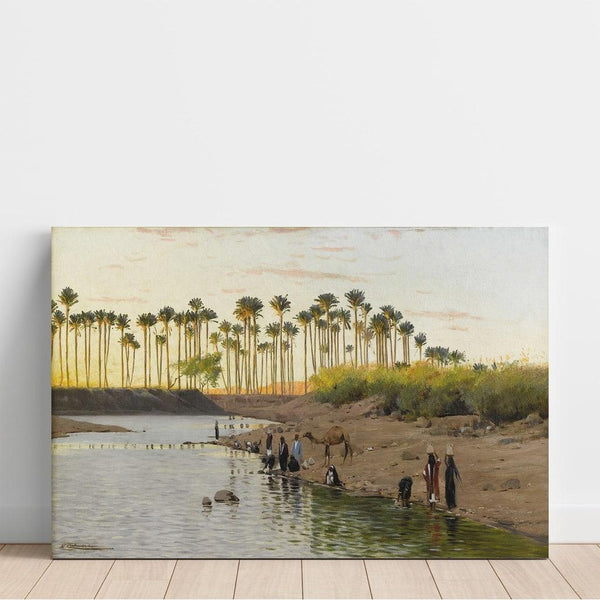
Kuhnert did not limit his interest to animals alone. During his stays, he also produced studies devoted to the landscapes and the people he encountered, as attested by a motif such as the portrait of an Arab man. These works, complementary to his wildlife scenes, reveal the same concern for fidelity to reality and the same taste for the attentive rendering of detail.
A body of work at the crossroads of art and science
One of the most notable aspects of Kuhnert's career lies in his contribution to scientific illustration. He was among the artists who provided plates for major German-language natural history publications, including the famous Brehm zoological encyclopedia, long regarded as a reference for the educated public. This collaboration perfectly illustrates the painter's particular position, between the world of art and that of naturalist knowledge.

In this context, accuracy was not a constraint endured but a requirement willingly embraced. Anatomical precision, the truthfulness of behaviour and the veracity of the setting served a documentary ambition: to show the animal as it really is. Yet Kuhnert was never merely an illustrator. His most accomplished canvases possess a properly pictorial dimension, through their sense of composition, their treatment of light and their ability to create an atmosphere. It is this alliance of rigour and sensitivity that explains the lasting reputation of his work.
Posterity and rediscovery
Wilhelm Kuhnert died in 1926. He left behind a substantial body of work that profoundly shaped the way the European public pictured African wildlife. Long disseminated through reproduction and illustration, his images exerted a considerable influence, to the point that certain visual conventions associated with the great wild animals owe much to him. His work thus belongs to a broader history, that of the gaze cast by Europe upon Africa in the colonial era, a dimension that contemporary scholarship does not fail to question.

In recent decades, Kuhnert's work has enjoyed renewed attention, notably through exhibitions and studies that place his career within its historical and artistic context. This rediscovery makes it possible to appreciate the technical quality of his painting while situating it lucidly within the debates that run through art history today. It confirms that the artist cannot be reduced to a single category: he was at once a methodical observer, a scientific illustrator and a painter in the full sense of the word.
For today's enthusiast, taking an interest in Wilhelm Kuhnert means recovering the trace of patient work, made of expeditions and hours of observation, placed in the service of a faithful representation of living things. His savanna scenes, his big cats and his elephants gathered at the water's edge continue to captivate through their balance between naturalist truth and pictorial presence. Through his paintings, it is a certain idea of wild nature, at once precise and grandiose, that reaches us and retains, a century later, all its evocative power.
Discover the full range of Wilhelm Kuhnert painting reproductions.