Among the landscape painters who turned the high mountains into a genuine pictorial genre, Edward Theodore Compton holds a singular place. An English-born painter settled in Bavaria, he was also a seasoned mountaineer, and this dual belonging — that of the studio and that of the rope party — nourished his entire body of work. His views of the Alps and the Dolomites combine an almost cartographic rigour of observation with a sensitivity to the luminous climate of high altitude. To approach Edward Theodore Compton is therefore to enter a painting in which intimate knowledge of the terrain becomes artistic material.
Edward Theodore Compton, an Englishman who became a painter of the Alps
Edward Theodore Compton was born in England in 1849, into a family in which culture and a taste for the arts held an important place. His training was built to a large extent on the practice of drawing and watercolour, techniques to which he would remain faithful and which partly explain the precision of his line. The artist's destiny shifted when his family settled on the continent: it was in the German-speaking world, and particularly in Bavaria, that he established his life and his studio.
This geographical move was no minor detail. By putting down roots in southern Germany, close to the Alpine arc, Edward Theodore Compton drew nearer to the motif that would become his own for a lifetime. The mountain ceased to be a distant, exotic subject and became a familiar environment, walked season after season. He died in Bavaria, at Feldafing, in 1921, after a long career almost entirely devoted to depicting the massifs he knew from within.

The painter-mountaineer: seeing the mountain from within
What sets Edward Theodore Compton apart from many landscape painters of his time lies in his actual practice of mountaineering. He did not paint the mountain from the valley or from surveys, but after having climbed it. An enduring climber, he moved in European mountaineering circles and himself reached the heights from which he then observed the peaks and glaciers. This physical experience of the terrain gives his compositions an accuracy of angle and an understanding of volume rarely found in those who have not felt the slope underfoot.
It should be remembered that the second half of the nineteenth century was the golden age of the conquest of the Alps, a period when the great ascents and the European alpine clubs shaped a new relationship with the high mountains. Edward Theodore Compton belongs to this context: his work engages in dialogue with this scientific and sporting enthusiasm for the summits. His images have, moreover, often served a documentary function, showing landforms, routes and panoramas with an exactitude appreciated by connoisseurs of the mountains.
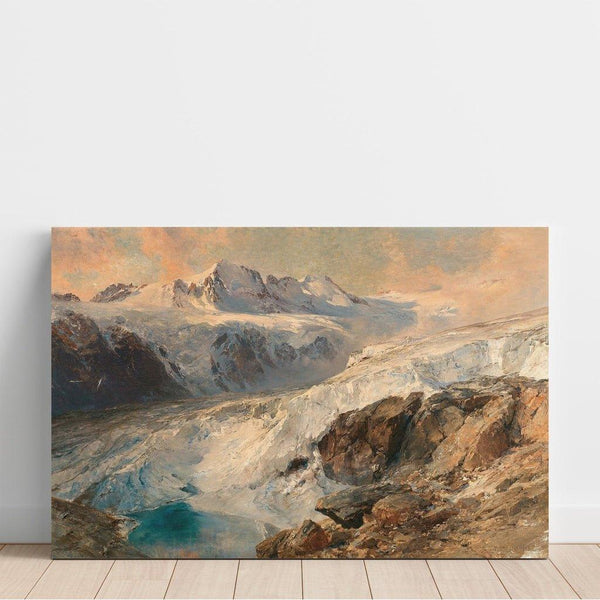
This dimension, however, does not confine his art to mere illustration. In Edward Theodore Compton's work, topographic precision is placed at the service of an atmosphere: the raking morning light on the snow, the transparency of the air at altitude, the silent mass of a rock face. Exactitude becomes a means of expression rather than an end in itself.
A body of work between topographic exactitude and emotion
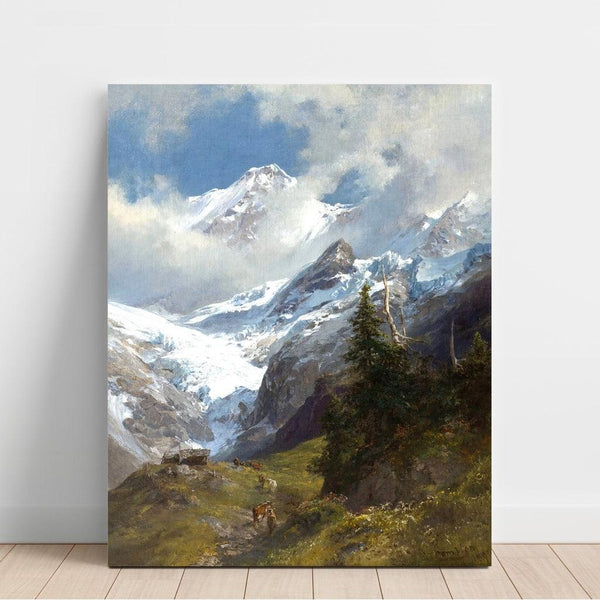
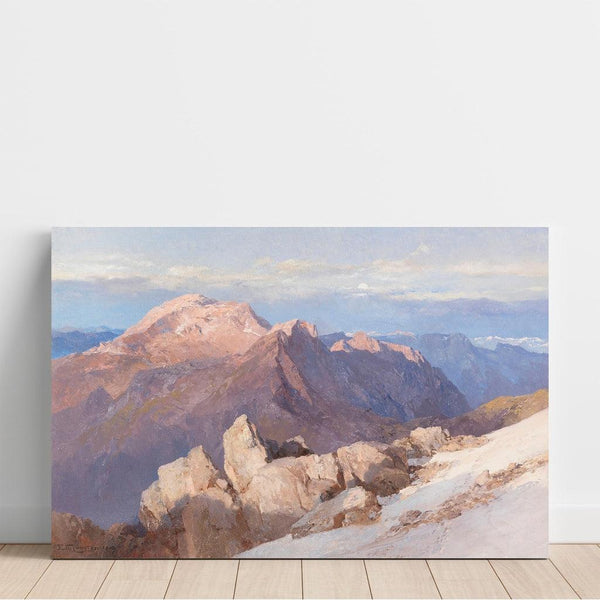
Edward Theodore Compton's repertoire is almost entirely devoted to the mountain landscape. His paintings and watercolours traverse the Alpine arc in all its diversity, from snow-capped summits to the sheer walls of the Dolomites. A work such as The Jungfrau illustrates his attachment to the great emblematic peaks of the Bernese Alps, while a title like High mountain landscape sums up on its own the essence of his research: to render the presence and scale of the high mountains.

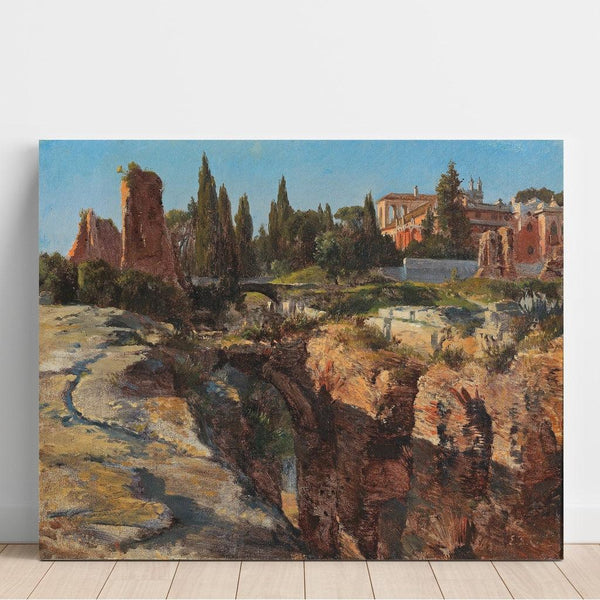
This interest in the variety of the massifs can also be read in more precisely situated motifs. The View of Mount Sassolungo, now offered as a reproduction, stages one of the most recognisable silhouettes of the Dolomites, whose towers of pale limestone particularly caught his draughtsman's attention. The View of the Hohensalzburg Fortress, also available as a reproduction, bears witness in turn to a gaze that knew, on occasion, how to combine relief with architecture, the citadel of Salzburg dominating the town from its hill. These two subjects recall the geographical breadth of his exploration, between high mountains and urban landscapes set against the relief.
On the technical level, mastery of watercolour is one of the foundations of his art. This medium, demanding and unforgiving of reworking, is well suited to rendering high-altitude skies, mists and gradations of snow. Edward Theodore Compton draws from it effects of great delicacy, while pursuing in parallel a practice of oil painting for his more monumental compositions. This suppleness between techniques accompanies the constancy of his subject.
Edward Theodore Compton's place in the history of mountain painting

To place Edward Theodore Compton in the history of art means linking him to the long tradition of mountain landscape, heir to Romanticism and its taste for the natural sublime. But his own contribution lies in the alliance of this sensitivity with a demand for exactitude nourished by direct experience of the summits. Where Romanticism often sought dramatic effect, Compton adds the credibility of the witness, the one who has seen with his own eyes the real configuration of the ridges and glaciers.
His work has lastingly mattered to mountain lovers and to the mountaineering community, who have recognised in his images both a reliable document and a celebration of the high-altitude landscape. The family tradition was moreover carried on, as his son also took up a career as a painter, which helped to inscribe the Compton name in the history of the genre.
Today, to rediscover Edward Theodore Compton is to recover a precise moment in European cultural history, the one in which art and the exploration of the summits advanced together. His landscapes do not merely describe places: they convey a way of looking at the mountain, made of attention and respect. It is this encounter between knowledge of the terrain and the painter's sensitivity that continues to give his work its value and its coherence.
Discover the full range of Edward Theodore Compton painting reproductions.