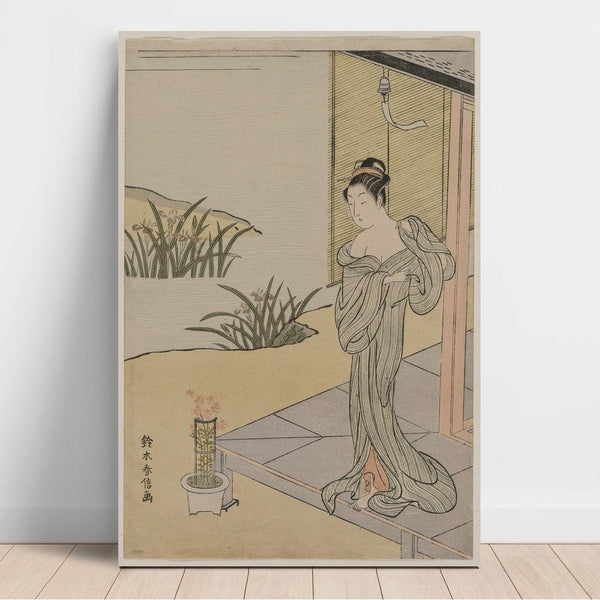
Among the great names of ukiyo-e, that "floating world" celebrated by Japanese artists from the seventeenth to the nineteenth century, Suzuki Harunobu holds a place apart. Active in Edo, present-day Tokyo, in the heart of the eighteenth century, he has come down in the history of the print as one of the decisive figures in the transition to colour. His slender female figures, his atmospheres steeped in poetry and his sense of refinement profoundly marked his era and continue to captivate lovers of Japanese art. This article offers a sober journey through his life, his technical innovations and his legacy.
An Artist of the Edo Period
Suzuki Harunobu, whose birth is generally placed around 1725, practised his art in Edo during a period of great cultural vitality. Under the Tokugawa regime, the city was then undergoing considerable growth; a prosperous urban population of merchants and scholars developed a pronounced taste for entertainment, literature, theatre and images. It was in this context that ukiyo-e, literally the "pictures of the floating world", flourished, offering a broad public scenes of everyday life, portraits of actors and depictions of female beauties.
Precise information about Harunobu's training and biography remains partly incomplete, as is often the case for printmakers of this period. It is known, however, that he emerged in the 1760s as a major figure on the Edo art scene. His career, though relatively brief, proved remarkably intense: he died in 1770, leaving an abundant body of work that would lastingly influence his contemporaries and successors.

The Invention of Nishiki-e
The name of Suzuki Harunobu is inseparable from one of the great innovations of the Japanese print: the nishiki-e, or "brocade picture". Before the 1760s, the woodblock print was most often limited to a few colours, applied by hand or printed in a restricted number of tones. The technical advances that made it possible to print multiple colours with great precision radically transformed the possibilities of the medium, and Harunobu found himself at the forefront of this development.
This turning point was closely tied to a particular practice: that of illustrated calendars, or e-goyomi, often commissioned by circles of amateur scholars for private exchange. These luxury images, produced with extreme care and no concern for economy, encouraged experimentation with polychrome printing of a new quality. Around 1765, this momentum gave rise to the fully coloured print as we know it. Harunobu helped to fix its aesthetic language, combining delicate harmonies, layered effects and meticulous attention to the detail of fabrics and settings.

Female Figures and the Art of Mitate
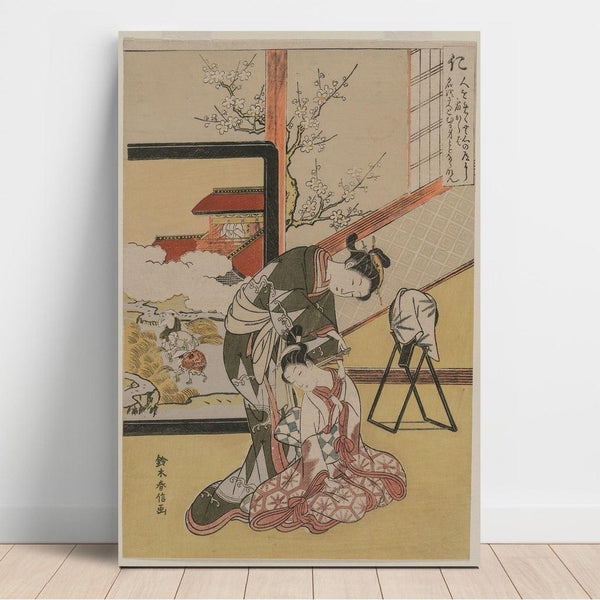
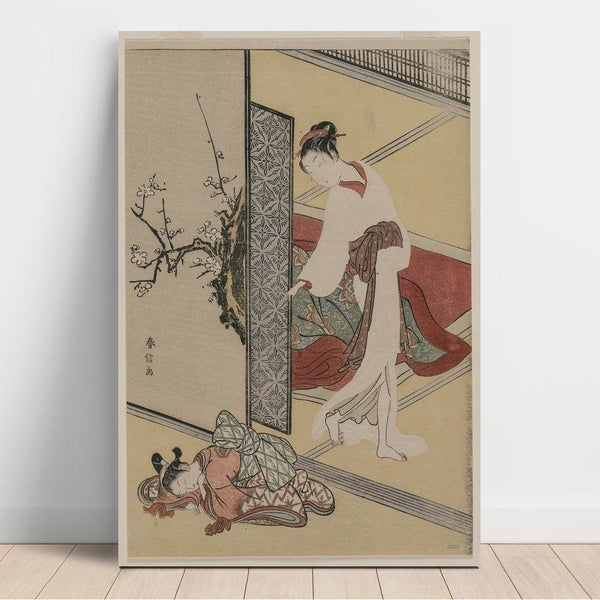
Harunobu's work is above all celebrated for its depictions of women, in the tradition of bijin-ga, the "portrait of beautiful women". His figures are distinguished by their slender silhouette, their almost unreal grace and a certain timelessness. Far from seeking an individualised portrait, the artist tended towards an ideal of delicacy: fine faces, restrained gestures, carefully arranged drapery. This aesthetic lends his prints a poetic atmosphere, often tinged with reverie, that makes them immediately recognisable.
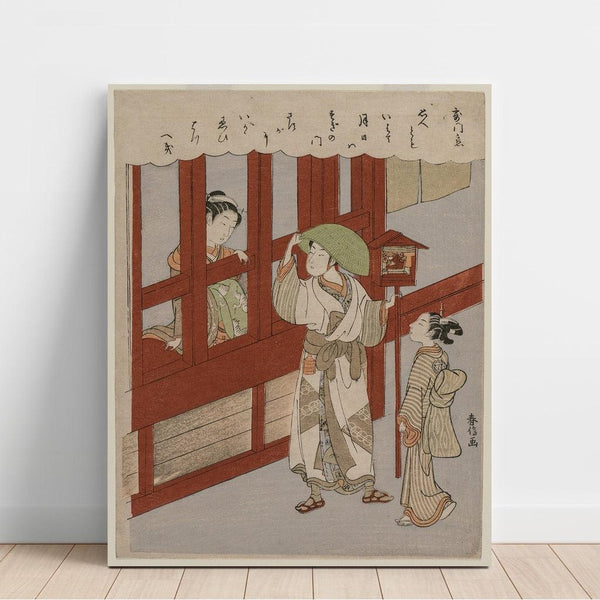
Harunobu also excelled in the genre of mitate-e, those compositions that transpose classical, literary or mythological themes into a contemporary setting, inviting the cultivated viewer to perceive the hidden reference. The print entitled "Mitate (Parody) of Young Woman as Daikokuten (God of Good Fortune)" illustrates this vein: a female figure evokes, in a light and allusive mode, one of the deities of good fortune. In the same way, a work such as "Dance of Autumn Leaves" attests to his taste for scenes imbued with delicacy and seasonal resonance, where nature discreetly accompanies emotion.

This dual dimension — formal beauty and the play of references — places Harunobu at the crossroads of the popular and the scholarly. His prints address an audience able to appreciate their graphic finesse as much as their erudite allusions, which partly explains the lasting esteem his work has enjoyed.
Legacy and Reproductions
The legacy of Suzuki Harunobu is considerable. By helping to establish the nishiki-e, he opened the way for generations of artists who would carry the Japanese print to its height. His influence can be read in the new attention given to colour, composition and the evocation of atmosphere, all achievements that the later great masters of ukiyo-e would inherit. More broadly, the Japanese print, of which Harunobu is one of the pioneers, would in the nineteenth century exert a profound fascination on Western artists, drawn to its framing, its flat areas of colour and its formal freedom.

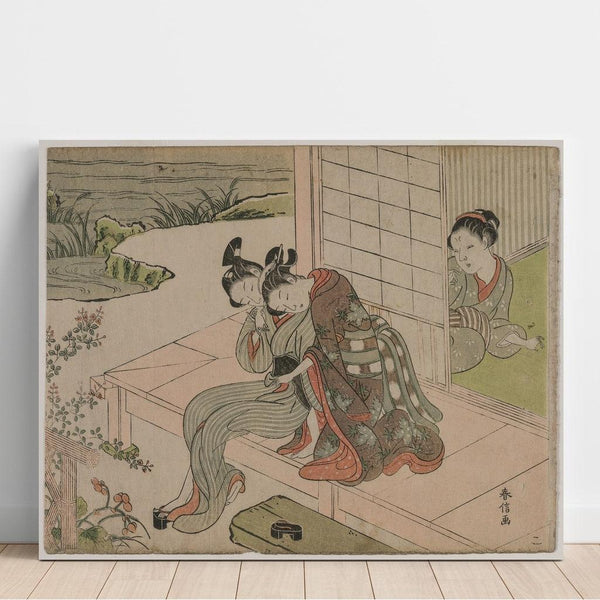
Today, his works are preserved and studied in numerous public collections around the world. They constitute precious testimonies to the life and imagery of eighteenth-century Edo, and offer a gateway into the refined universe of ukiyo-e. For those who wish to bring this elegance into their home, reproductions make it possible to rediscover the softness of his line, such as the "Bush Clover painting - Suzuki Harunobu" or the "Woman and Maidservant painting - Suzuki Harunobu", which carry on the memory of an artist whose gaze upon beauty remains remarkably current.
To rediscover Suzuki Harunobu is thus to measure how a body of work born in eighteenth-century Japan can still speak to our sensibility. Between technical innovation and visual poetry, he embodies a pivotal moment in the history of the print, where colour becomes the vehicle of a muted emotion. His name deserves a place among those that every lover of Japanese art would do well to know.
Discover the full range of Suzuki Harunobu painting reproductions.