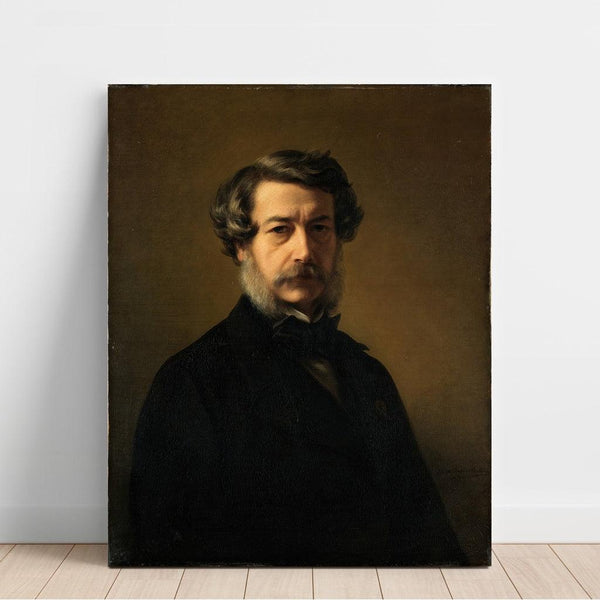
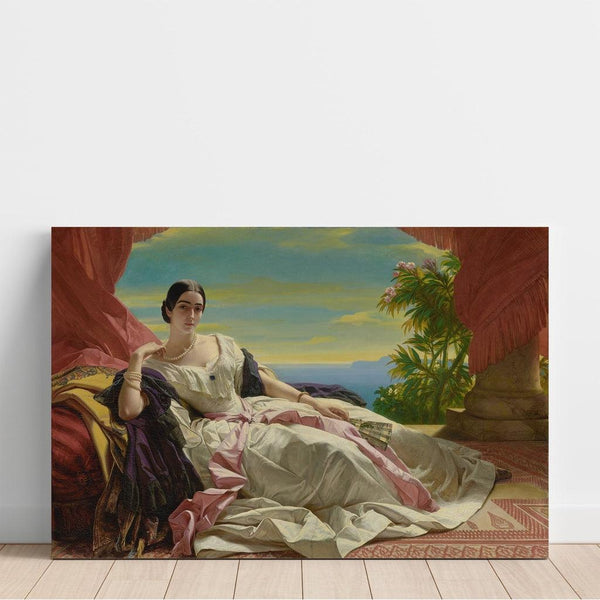
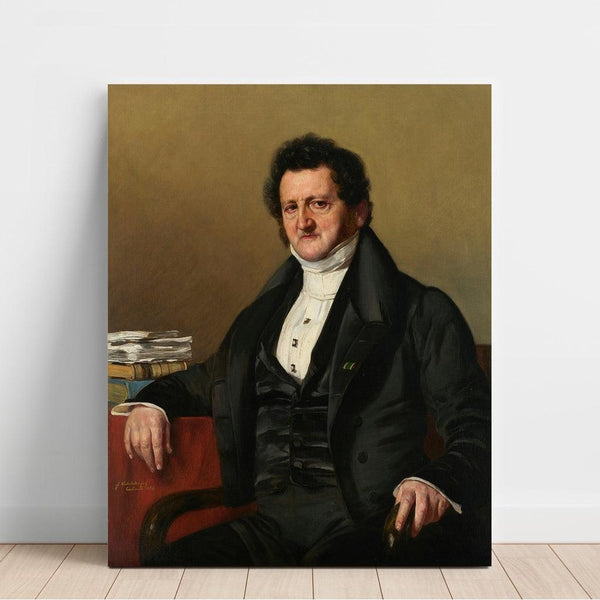
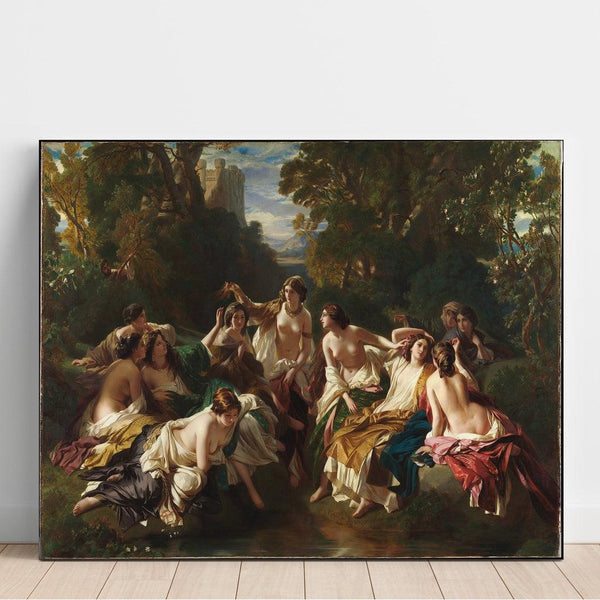
A nineteenth-century German painter, Franz Xaver Winterhalter (1805-1873) ranks among the most sought-after portraitists of the European courts of his time. His name remains associated with a refined image of the aristocracy and royalty, captured with a keen sense of elegance, light and fabric. From the France of Louis-Philippe and Napoleon III to the England of Queen Victoria, he immortalised the faces of a monarchical Europe in the midst of change, leaving a body of work that remains a valuable source for the history of costume, taste and the representation of power.
A training between the Black Forest and Munich
Franz Xaver Winterhalter was born in 1805 in Menzenschwand, a village in the Black Forest, in the Grand Duchy of Baden. Coming from a modest background, he showed an aptitude for drawing very early on. He first trained in the techniques of engraving and lithography, before continuing his apprenticeship at the Academy of Fine Arts in Munich, then one of the great artistic centres of the German-speaking world.
This dual culture, that of applied drawing and that of academic painting, left a lasting mark on his manner. It gave him both a great mastery of line and a sense of composition that would make the reputation of his portraits. His brother Hermann Winterhalter, also a painter, accompanied him for part of his career and sometimes collaborated on his work. These patient beginnings, far from the splendour he would later depict, explain the technical solidity that underpins the apparent ease of his mature works.

The painter of the European courts
Winterhalter's career took off in the Grand Duchy of Baden, where he became a painter attached to the court. His portraits of princely figures quickly earned him a renown that reached beyond the German borders. It was, however, his move to Paris that determined the course of his life. There he became one of the favourite portraitists of the July Monarchy and then, under the Second Empire, of the imperial couple formed by Napoleon III and the Empress Eugénie.
From then on his reputation attracted an international clientele. He worked for several European courts, notably those of France, Belgium and England, where Queen Victoria and Prince Albert called upon his services. This movement from one court to another is characteristic of his position: Winterhalter embodied a form of official portraiture shared by the elites of the continent, able to meet the codes of representation expected by sovereigns while flattering their individuality.

This favour of the courts was not merely a matter of talent: it also stemmed from his ability to understand the expectations of demanding patrons. The court portrait was then a political and social instrument as much as a work of art. Winterhalter knew how to reconcile the function of representation, which calls for pomp and dignity, with an attention to the naturalness of poses that makes his sitters lively rather than frozen in a conventional attitude.
A style in the service of aristocratic elegance
Winterhalter's style is recognisable by the combination of precise drawing and a delicate rendering of materials. Silks, laces, furs and jewels are treated with a virtuosity that contributed greatly to his popularity. His compositions favour harmony and clarity, highlighting the sitter's face and figure without ever weighing down the whole. This smooth and graceful manner, sometimes judged too seductive by the critics of his day, matched the taste of a clientele eager to appear in its best light.

Among the works that bear witness to this art of portraiture, one may mention a Portrait of a lady, which illustrates his ease in setting a female figure in an understated elegance, as well as a Portrait of the Duchess of Alba, associated with the high aristocracy of his time. These examples recall the central place occupied by the female portrait in his output. Winterhalter contributed greatly to fixing an idealised image of the high-society woman, between restraint and refinement, that remains attached to his name.
Beyond the strict commissioned portrait, his work also makes room for compositions of a more sensitive or picturesque register, in which the artist explores the softness of atmospheres and the grace of poses. This part of his work, less bound by official requirements, reveals a painter attentive to the charm of a scene and the poetry of a moment, extending by other means the qualities already present in his portraits.
A legacy and a rediscovery

Despite considerable fame during his lifetime, Franz Xaver Winterhalter remained discreet about his private life, which was entirely devoted to his work. His reputation went through, like that of many nineteenth-century academic painters, a period of relative eclipse, before art history reassessed his importance. Today the quality of his craft and the documentary value of his work are recognised, a precious testimony to the customs, costumes and imagination of the European courts.
This rediscovery is accompanied by a renewed interest among enthusiasts in his compositions, some of which are offered as reproductions. Such is the case with the Painting The Siesta - Franz Xaver Winterhalter, which illustrates the more intimate and sensitive side of his art, or the Painting Roman Genre Scene - Franz Xaver Winterhalter, in which the painter moves away from the official portrait to take up a more narrative and picturesque register. These reproductions make it possible to bring a part of this refined world into one's home.
To rediscover Winterhalter is thus to find again a privileged witness to an era in which the portrait served as a social mirror and an affirmation of rank. Between technical mastery and a sense of elegance, his work continues to offer enthusiasts and historians alike a sensitive access to the splendour and visual codes of nineteenth-century Europe, of which he remains one of the most accomplished interpreters.
Discover the full range of Franz Xaver Winterhalter painting reproductions.