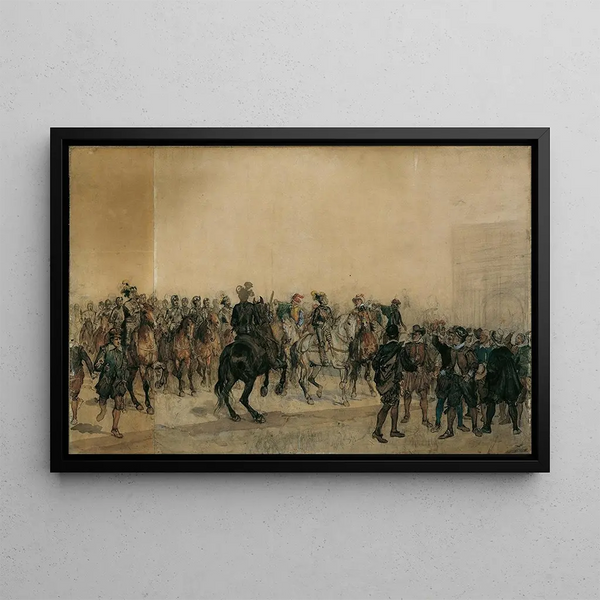
A representative figure of nineteenth-century Austro-Hungarian painting, Sigmund L'Allemand (1840-1910) belongs to that generation of Viennese artists who made portraiture and historical scenes the mirrors of an imperial society in full self-assertion. Active in Vienna during the long reign of Emperor Franz Joseph, he established himself as a portraitist sought after by the aristocracy, the army and the senior administration of the Danubian monarchy. His work, rooted in the academic tradition, offers today a precious testimony to the faces and uniforms of a bygone age. This article proposes a sober and documented journey through his life, his manner and the portraits that made his reputation.
A Viennese painter in the age of Franz Joseph
Sigmund L'Allemand was born in Vienna in 1840 and died there in 1910, having lived through a decisive period for the culture of the Austro-Hungarian capital. His training took place in the Viennese academic milieu, then dominated by the teaching of fine arts and by the prestige of history painting. He moved in a context where official art played a leading role: public commissions, portraits of dignitaries and compositions on military subjects sustained the activity of the studios.
The surname L'Allemand is associated, in the history of Austrian painting, with battle painting, a genre in which Fritz L'Allemand distinguished himself, and to whom Sigmund is connected by family lineage and by attentive apprenticeship. This closeness to the tradition of the military picture lastingly shaped the orientation of his work. Trained in the discipline of drawing and the rigour of composition, he inherited a visual culture in which documentary precision counted as much as the overall effect.

Recognised in his lifetime, L'Allemand held a respected place within the Viennese artistic institution. His teaching and his activity as a painter fell within the continuity of academicism, at a moment when it remained the dominant reference, before the ruptures of the Vienna Secession redefined, at the end of the century, the horizons of Austrian art.
The portraitist of the Austro-Hungarian elite
It is above all as a portraitist that Sigmund L'Allemand left his mark. His sitters belonged to the ruling circles of the monarchy: statesmen, senior officials, high-ranking officers. The official portrait, as he practised it, answered a precise function. It was not merely a matter of capturing a likeness, but of conveying a dignity, a function, a rank. The pose, the gaze, the dress and the insignia all took part in this construction of the public image.

Among the figures he portrayed is Paul Gautsch von Frankenthurn (1851-1918), an Austrian statesman who served on several occasions as head of the government of Cisleithania. The portrait of this minister illustrates the way in which L'Allemand places the sobriety of the framing at the service of the sitter's authority: presence is asserted without emphasis, in a careful execution that favours the legibility of the face and the composure of the whole.
The painter also devoted himself to the military figures of the monarchy, such as the cavalry general Alexander Freiherr von Koller, whose features he set down with the same attention. In these effigies of officers, the uniform and its details take on particular importance: decorations, braids and attributes are rendered with an exactitude that owes as much to documentary concern as to the art of portraiture. These works thus combine the tradition of the ceremonial portrait with the visual culture proper to military painting.
Between ceremonial portrait and the culture of military painting
The manner of Sigmund L'Allemand is characterised by a masterful execution, faithful to the principles of Viennese academicism. The drawing is firm, the composition balanced, the colour used with measure. This approach aims less at formal innovation than at accuracy: to make the sitter recognisable, to situate his function, to render the substance of fabrics and metals. In the ceremonial portrait, this rigour becomes a codified language, in which each element contributes to the expression of a social status.

The attention paid to uniforms and insignia is not incidental. It attests to the place the army occupied in the imagination and the organisation of the Austro-Hungarian Empire. Here the painter takes his place within a tradition in which the officer's portrait and the military scene answer one another, both requiring a precise knowledge of dress, ranks and customs. This visual culture brings his work close to that of the battle painters of whom he is the heir, while keeping it within the more intimate register of the portrait.
Through this dual belonging, L'Allemand's work offers a nuanced reading of the official painting of his time. It does not seek to idealise its sitters in the abstract, but to inscribe them within a social and institutional order of which it gives a clear and ordered image. It is this clarity, allied to a careful execution, that gives his portraits their documentary and aesthetic value.
A body of work to rediscover today

Long associated with an official art that fell out of fashion after the rise of the avant-gardes, Sigmund L'Allemand deserves a renewed look. His portraits form a gallery of Austro-Hungarian society at its apogee, precious for the historian as for the art lover. They remind us that academicism, often reduced to its conventional dimension, rested on a demanding craft and on a genuine intelligence of representation. Each effigy condenses a moment in the political and military history of the Empire.
Today, these works find their public again thanks to quality reproductions, which make it possible to introduce into a contemporary interior the sober presence of an old portrait. The portrait of Minister Paul Gautsch von Frankenthurn or that of the cavalry general Alexander Freiherr von Koller offer, in this setting, the occasion for a dialogue between today's décor and the memory of an era. Chosen with discernment, these reproductions enhance a space while paying homage to a pictorial mastery.
To rediscover Sigmund L'Allemand is thus to reconnect with a tradition of portraiture in which measure and precision prevail over effect. His work invites a patient contemplation, attentive to faces and to details, and reminds us that a painting can be at once a historical document and a work of art. For those who wish to understand the visual culture of imperial Vienna, it remains a discreet but illuminating point of reference.
Discover the full range of Sigmund L'Allemand painting reproductions.