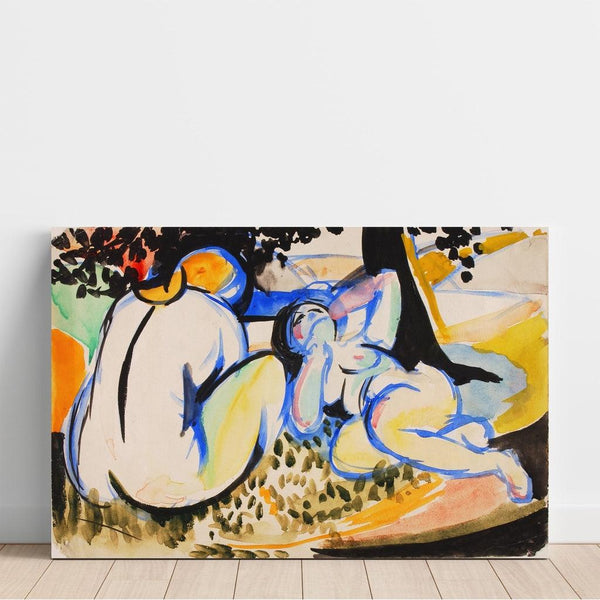
Some painters come to art by a roundabout path, and that detour nourishes their entire body of work. Henry Lyman Sayën belongs to that rare category of artists who came from the applied sciences before fully embracing painting. An engineer and recognised inventor in the field of X-rays, then a modernist painter marked by the Parisian avant-garde, he embodies a singular trajectory within early twentieth-century American modernism. Having died prematurely, he left only a relatively small body of paintings, yet it is enough to reveal an attentive colourist and a methodical mind, equally at ease with light and with structure. To discover Sayën is to follow an artist who carried the precision of the engineer into the exploration of colour.
A path between science and painting
Born in Philadelphia in 1875, Henry Lyman Sayën first trained in science and technology. He made a name for himself as an engineer at the very moment when electricity and X-rays were opening up entirely new fields of research. He is credited in particular with work on X-ray tubes, an area in which he filed patents and developed devices intended to make these instruments more reliable. At a time when radiography was in its infancy, these contributions placed him at the cutting edge of the technical innovation of his day.
Yet this scientific culture never extinguished his artistic vocation. Sayën turned to painting and studied at the Pennsylvania Academy of the Fine Arts, a major institution of American artistic training, where he worked alongside Thomas Anshutz, an influential figure in academic teaching in Philadelphia. This dual grounding, between laboratory and studio, sheds light on part of his approach: for him, patient observation of the world and a taste for experimentation did not stand in opposition, they extended one another. The painter inherited from the engineer a rigorous way of approaching his subject, while the artist offered the technician a freer field of invention.

Paris, colour and the influence of the avant-garde
Like many Americans of his generation eager to confront modernity, Sayën made his way to Paris, where he stayed during the years preceding the First World War. The French capital was then the bustling home of the boldest research into form and colour. Fauvism had recently caused a scandal there, the art of Henri Matisse and those close to him was redefining the role of pure colour, and the nascent Cubism was in turn overturning the representation of space. For an artist coming from the American academic tradition, such an environment amounted to a genuine jolt.
Sayën absorbed these lessons with discernment. Above all he retained the expressive power of colour freed from its purely descriptive function, the organisation of the canvas into coloured planes and the attention paid to the decorative motif. Without merging into any particular school, he made the freedoms of European modernism his own, adapting them to his own sensibility. These Parisian years acted as a catalyst: they transformed a solidly trained painter into a resolutely modern artist, open to simplified forms and frank chromatic harmonies. On his return to the United States, he was among the intermediaries who helped spread the spirit of the European avant-garde within an American art world still largely attached to older conventions.

A body of work between light, motif and abstraction
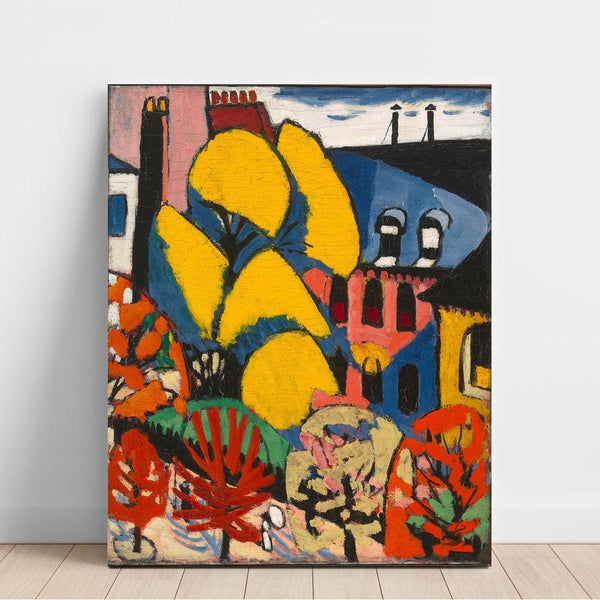
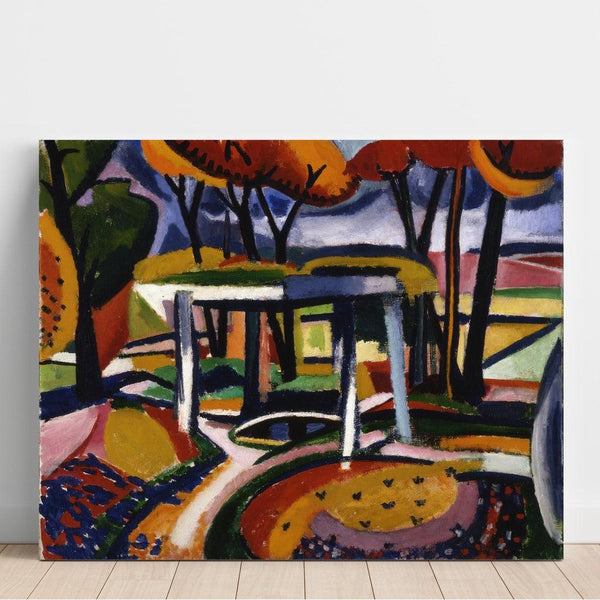
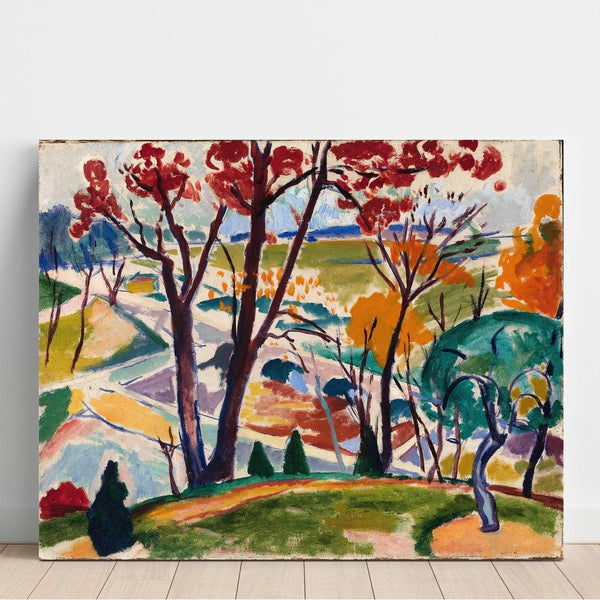
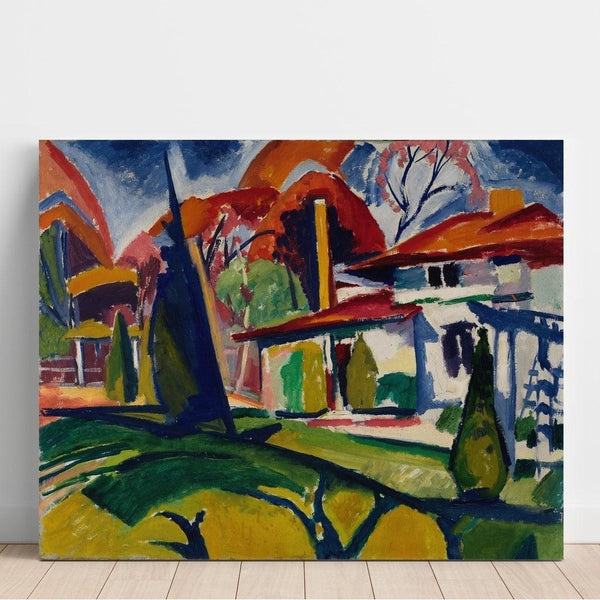
Sayën's output bears witness to a constant dialogue between the observation of reality and formal research. His painting stands out for its vivid colours, balanced compositions and a keen sense of the surface, where the subject often bends to the demands of rhythm and decorative harmony. In it one perceives the echo of the Parisian lessons, but also a personal restraint, a determination to hold together the spontaneity of colour and the clarity of construction.
Works such as Anemones illustrate his taste for the floral motif, a favoured terrain where colour can unfold freely while remaining anchored in a familiar subject. The still life and the bouquet, traditional themes if ever there were any, become for him pretexts for the arrangement of tones and forms, in the spirit of modernist research into the decorative. At the other end of his approach, a painting such as Abstract Landscape shows just how far he pushes simplification: the landscape resolves into planes and zones of colour, the reference to the motif fading in favour of a more autonomous organisation of the canvas. This movement towards abstraction, still rare among American painters of his time, underlines the boldness of an artist attentive to the most recent developments.

This oscillation between coloured figuration and abstract temptation constitutes one of the major points of interest of his work. It is a reminder that American modernism was not built as a single block, but through individual paths where each artist negotiated the European heritage in his own way. Sayën occupies a place apart in it, that of an experimenter who approached painting with the same methodical curiosity he had put at the service of science.
A quiet legacy and a rediscovery
Sayën's artistic career was brief. His death, which came in 1918, cut short a trajectory in full development and deprived American modernism of a promising voice. This shortened destiny partly explains the relative obscurity of his name, long left in the shadow of more famous figures of the avant-garde. The limited body of his paintings and the dispersal of his work contributed to this quiet standing.

His legacy has nonetheless been preserved and reassessed. A significant part of his output is held in American public collections, which has allowed art historians to reconstruct his path and gauge his contribution. Studies devoted to American modernism today credit him with having introduced early on certain chromatic and formal boldnesses inherited from Paris. His double life as engineer and painter, far from being a mere biographical curiosity, appears as the key to a body of work in which rigour and invention answer one another.
To rediscover Henry Lyman Sayën is thus to bring to light an often neglected link in the history of modern art in the United States. His canvases, now accessible to the amateur public in the form of reproductions such as The Winds or Anemones, invite a longer look at a painter for whom colour was a true field of experimentation. Between the precision of the scientist and the freedom of the artist, his work retains a freshness that fully justifies the renewed attention it is receiving.
Discover the full range of Henry Lyman Sayën painting reproductions.