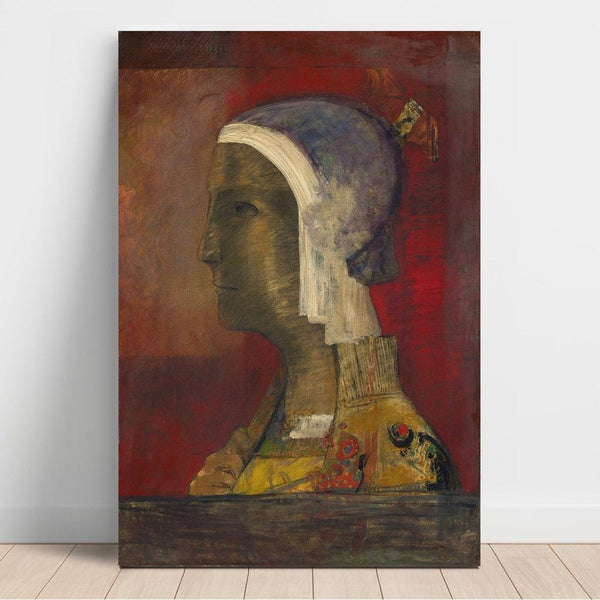
A singular figure of French painting, Odilon Redon holds a place apart in the art history of the late nineteenth century. A painter, draughtsman and lithographer, he built a body of work divided between shadow and light: on one side, a graphic universe haunted by dream and the fantastic; on the other, floral compositions of dazzling chromatic richness. Associated with Symbolism, Redon preferred suggestion to description and the imaginary to the imitation of reality. This page offers a sober journey through his life, his major periods and his legacy, while presenting a few reproductions intended for enthusiasts who wish to keep a trace of it in their home.
A journey between Bordeaux and Paris
Odilon Redon was born in Bordeaux in 1840. His youth in the Médoc, spent partly on the family estate of Peyrelebade, nurtured very early a sensitivity to solitude and reverie. Drawn to drawing, he benefited from the company of two decisive men: the botanist Armand Clavaud, who introduced him to the natural sciences and to literature, and the engraver Rodolphe Bresdin, whose teaching revealed to him the resources of etching and lithography. A spell in the studio of Jean-Léon Gérôme, at the École des Beaux-Arts in Paris, by contrast ended in disappointment: academicism suited his nature poorly.
Redon's training thus took shape on the margins of official paths. Sensitive to music, poetry and the sciences of his time, he developed a personal language that owed as much to observation as to introspection. In 1884, he was among the founders of the Société des Artistes Indépendants, alongside a generation eager to renew the modes of exhibition. He then divided his life between Paris and the south-west, before enjoying, in his final decades, a growing recognition. He died in Paris in 1916.

The "noirs": the realm of dream and the fantastic
For much of his career, Redon worked almost exclusively in black and white. Charcoals and lithographs make up what are known as his "noirs", a body of work in which the artist explores the uncertain regions of the mind. Floating eyes, hybrid creatures, faces emerging from the half-light: these images do not tell a precise story but open a field of free associations. In them Redon lays claim to a kind of "logic of the visible in the service of the invisible", placing imagination at the heart of his approach.
Literature plays an essential role in this imaginative world. Redon devoted lithographic series to Edgar Poe, to Baudelaire, to Gustave Flaubert and to other writers whose universe resonated with his own. His plates, often accompanied by evocative captions, thus extend the text rather than illustrate it. Prints such as Volupté, fantôme élastique! (Pleasure, elastic phantom!) or Sans cesse à mes côtés s'agite le démon (Ceaselessly by my side the demon stirs) bear witness to this vein, where the title itself contributes to the atmosphere of unease and dream.

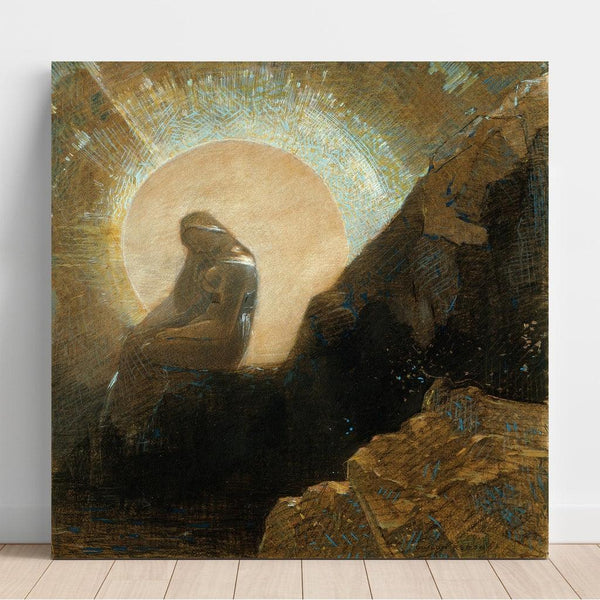
These graphic works earned Redon the esteem of Symbolist circles and of many writers, who recognised in him a kindred spirit. Far from the dominant naturalism, he offered a painting of inner life, attentive to dreams, myths and states of consciousness. It was on this ground that his reputation was first built, before colour came to transform his art profoundly.
The turn to colour
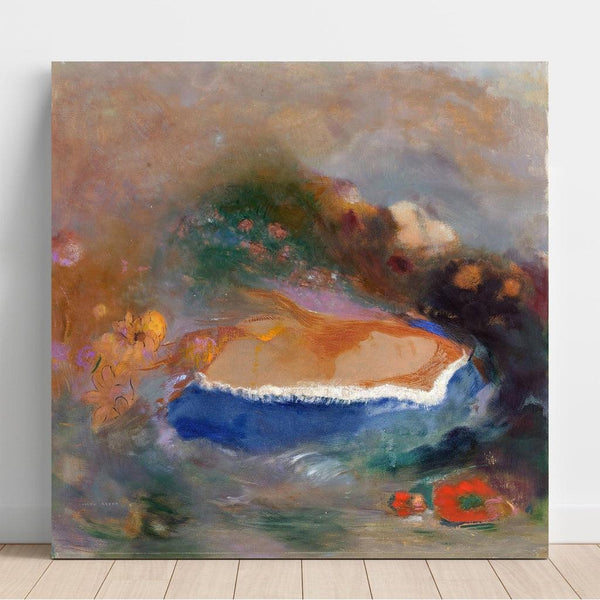
From the 1890s onwards, and still more at the turn of the century, Redon gradually abandoned the exclusive use of black to embrace colour. Pastel and oil took over from charcoal, and his palette opened up to luminous harmonies, at times almost unreal. This shift did not disown the imaginative world of the "noirs": it transposed it into a more solar register, where flowers, mythological figures and faces bathe in a suspended light.

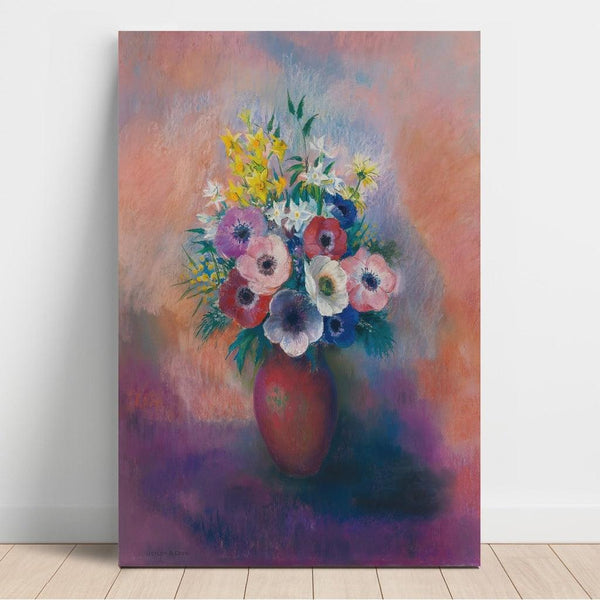
Bouquets are among the most celebrated motifs of this period. In them Redon observes flowers with the precision inherited from his botanical culture, while freeing them from any descriptive constraint: the vases seem to float, the backgrounds dissolve into sheets of colour, and the composition owes as much to dream as to still life. The pastel Violette Heymann, made in 1910, illustrates this manner, in which a portrait blends into a floral profusion of great delicacy.
To extend this encounter, two works are offered as reproductions: the Violette Heymann Painting - Odilon Redon | Reproduction and the Large Bouquet of Wild Flowers Painting - Odilon Redon | Reproduction. Faithful to the artist's colourful spirit, they make it possible to bring into an interior this poetry made of nuances and transparencies, without betraying the subtlety of the originals.
A lasting Symbolist legacy

Redon's influence is measured first among the young painters of his time. The Nabis, among them Pierre Bonnard, Édouard Vuillard and Maurice Denis, saw in him a respected elder, sensitive as they were to the expressive value of colour and to the spiritual dimension of art. His presence in the major exhibitions of the early twentieth century, as well as the attention paid to him by collectors and critics, confirmed the importance of his work during his lifetime.
Beyond his own era, Redon left a lasting mark on the history of Symbolism and prepared, in his own way, certain audacities of the twentieth century. His refusal to separate the visible from the invisible, his trust in imagination and his sense of colour made him a reference for anyone interested in the links between art, dream and poetry. His works are today held in many museums and continue to be studied as a major milestone of nascent modernity.
To discover Odilon Redon is thus to travel a coherent itinerary, from the meditative darkness of the "noirs" to the flowering of colour. His flowers as much as his figures invite a patient gaze, attentive to inner resonances as much as to the beauty of forms. For enthusiasts, a carefully made reproduction offers a sober way of bringing this sensibility to life day by day, in keeping with a body of work that remains, more than a century after the artist's death, singularly alive.
Discover the full range of Odilon Redon painting reproductions.