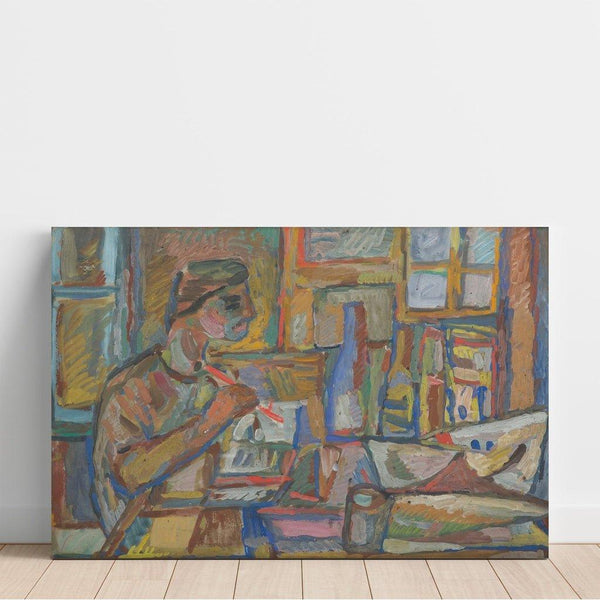
A discreet yet singular figure of interwar European art, Sasza Blonder belongs to that generation of Central European artists who, trained amid the ferment of the avant-gardes, later found in France a second homeland and a second language. A Polish painter of Jewish origin, active first in the seething milieu of Cracow and then in that of Paris, he pursued a relatively brief body of work yet one shaped by profound transformations: from the constructed, dreamlike vocabulary of his early years to a more sensitive and luminous landscape painting, signed under another name. To retrace his path is to follow the thread of a modernity that hesitates, transforms itself and reinvents itself in the wake of exile.
From Galician origins to the Cracow avant-garde
Sasza Blonder was born in 1909 in Galicia, a region then situated on the eastern edges of the Austro-Hungarian Empire before returning to Poland in the aftermath of the First World War. Like many artists from this cosmopolitan territory, he grew up in an environment where several cultures and several languages intersected, a fertile ground for a sensibility open to new ideas. His training led him to the Academy of Fine Arts in Cracow, an institution that remained at the time one of the principal centres of Polish artistic life.
It was in this context that Blonder joined the avant-garde movement of his city. He was among the young artists who, in the early 1930s, formed the Grupa Krakowska — the Cracow Group —, a collective bringing together creators driven by progressive convictions and a firm desire to break with academicism. This circle, which included figures who would leave a lasting mark on modern Polish art, constituted a decisive space of exchange for Blonder. There, aesthetics were debated as much as society, and formal experimentation went hand in hand with an engagement with one's own time.

Between Cubism and Surrealism: the formal explorations
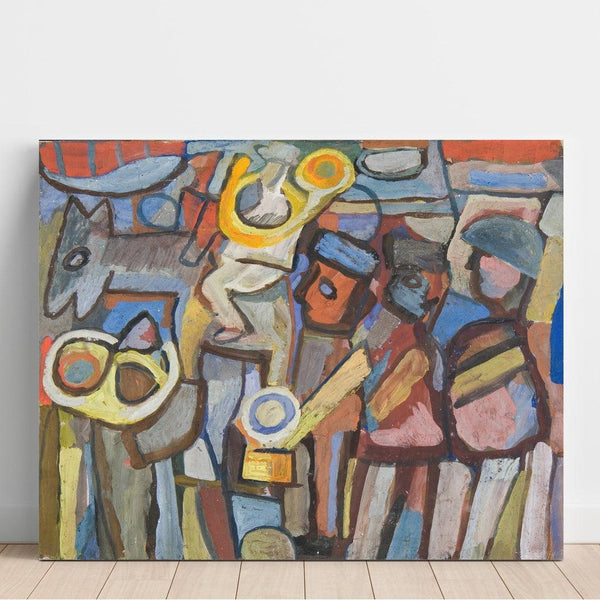
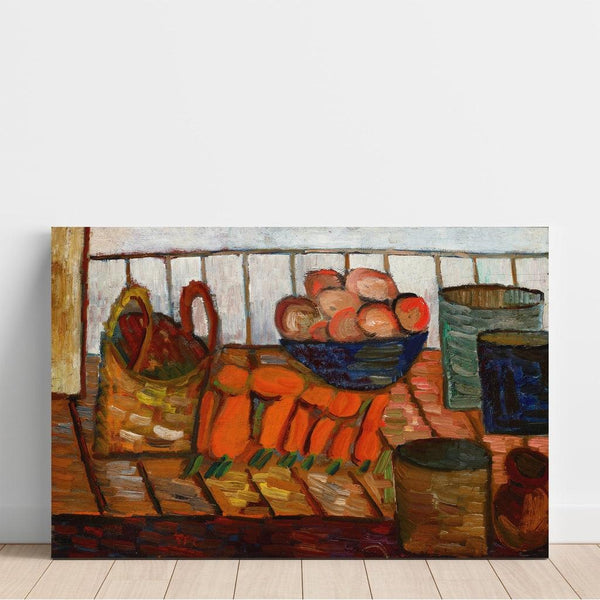
Sasza Blonder's first manner falls within the wake of the great explorations of European modernity. He absorbed the lessons of Cubism and of the constructive currents, then let himself be won over by the surrealist imagination that at the time irrigated much of the Parisian and international scene. His painting from this period favoured the rigorous organisation of space, the interplay of planes and forms, without renouncing a poetic and enigmatic dimension.
Works such as Composition with the inscription "WEGIELD" attest to this taste for constructed arrangement, in which the introduction of a word or a sign into the pictorial field recalls the experiments of the avant-gardes around collage and the integration of language into the image. The Surrealist Landscape with a Fence, for its part, belongs to that dreamlike vein: the banal motif of a fence becomes a pretext for a strange staging, in which reality gently unravels. These pieces express the artist's dual allegiance, torn between the logic of construction and the call of the unconscious, two poles that structured the art of the period.

This phase of his career reveals a curious temperament, attentive to the movements of his time, capable of bringing seemingly opposed sources into dialogue. Far from imitating a single model, Blonder sought his own way by confronting the available languages, in a spirit of exploration that characterises his entire path.
French exile and the metamorphosis into André Blondel
Like many of his contemporaries drawn by the prestige of the capital of the arts, Blonder made his way to France in the 1930s. Paris then offered artists from all over Europe an extraordinary place of confrontation, where schools, galleries and studios rubbed shoulders. His settling in France marked a turning point: it corresponded to a gradual shift in his painting, which little by little moved away from abstraction and dreamlike reverie to reconnect with the observation of the visible world.

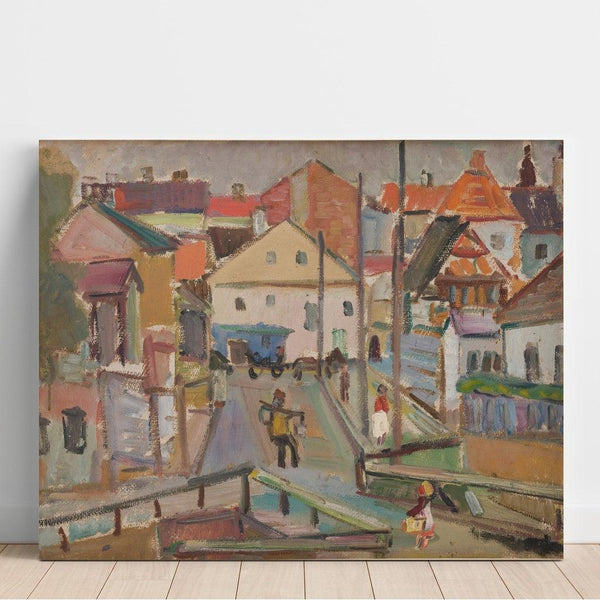
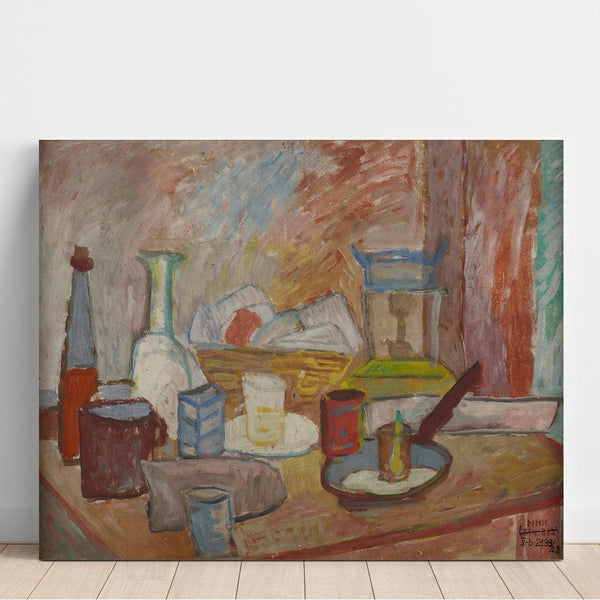
The ordeals of the Second World War weighed heavily on this trajectory, as on that of so many Central European Jewish artists who took refuge in France. At the close of the conflict, the artist adopted the name André Blondel, under which he henceforth continued and signed his work. This change of identity accompanied an aesthetic evolution: Blondel's painting became more direct, more sensitive to light and colour, turned towards the landscape and the motif captured from life.
Canvases such as Sunset over the Post Office of Sceaux or Boulevard Roumens, Carcassonne illustrate this final period. In them one senses a painter attentive to the atmosphere of a place, to the quality of a time of day, to the way an ordinary piece of architecture is set within its surroundings. The subject is no longer a pretext for construction or enigma, but a point of anchorage in French reality, between the Paris region and the Midi. This landscape painting, in which the post-impressionist heritage surfaces, testifies to a calming of the gaze and a renewed relationship with nature and the city.
A body of work between two languages and its posterity

The path of Sasza Blonder, who became André Blondel, offers an exemplary illustration of the artistic circulations that made the first half of the twentieth century so rich. Trained in the Polish avant-garde, nourished by cubist and surrealist experiments, he was able, through exile, to bring about a sensitive conversion towards a more intimate and more luminous painting. This dual face — the experimenter of the Cracow years and the landscape painter of the French years — constitutes the whole singularity of his work.
Gone in 1949, at the age of forty, the artist did not enjoy the long career that might have secured his renown. His name remains less famous today than those of some of his contemporaries, yet it occupies no less a real place in the history of the Polish avant-garde as well as in that of the foreign painters of the School of Paris. The collections and studies devoted to the Grupa Krakowska help to keep his memory alive.
For the art lover, rediscovering Sasza Blonder means measuring how far an artistic journey can unfold between several worlds without ever losing its inner coherence. From the constructed compositions of his beginnings to the light-bathed landscapes of his maturity, one and the same demand runs through his work: that of a painter who never ceased to search, to move and to renew himself, faithful to the spirit of exploration that defines modernity.
Discover the full range of Sasza Blonder painting reproductions.