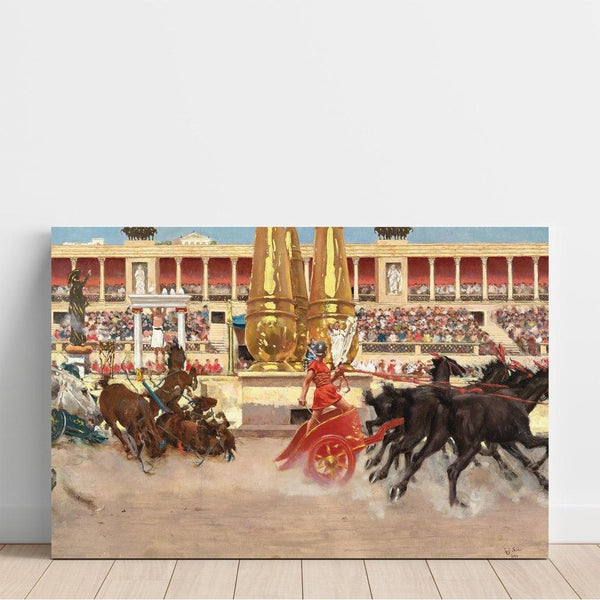
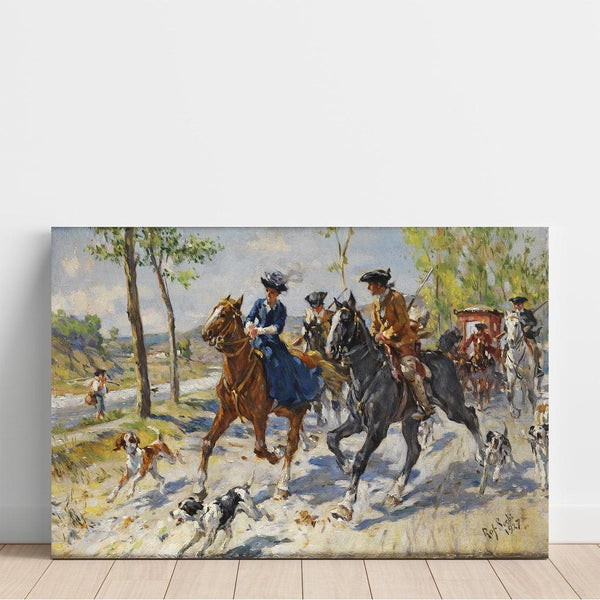
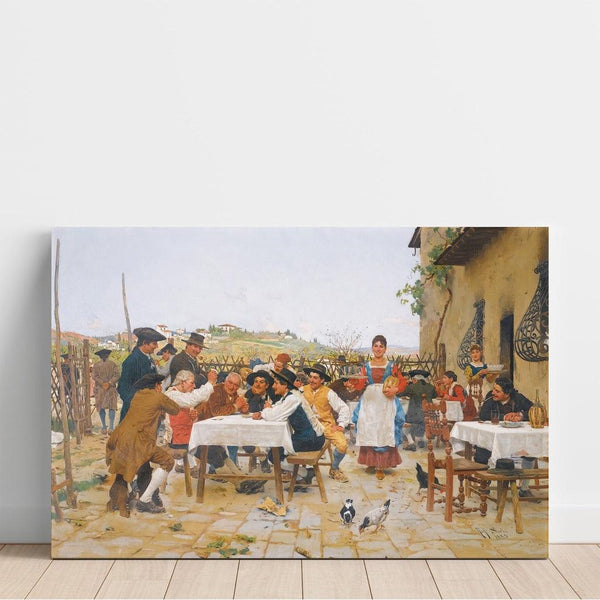
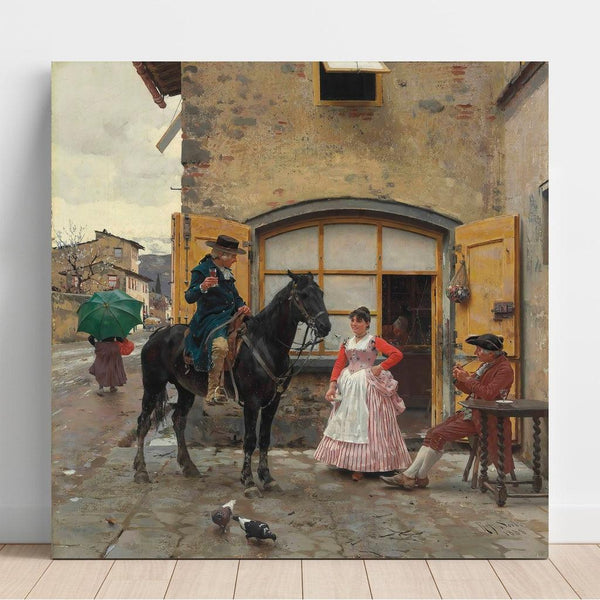
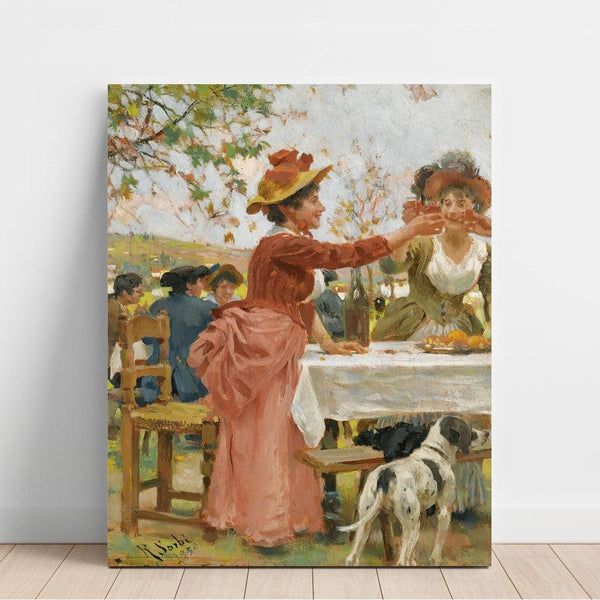
Among the Italian painters of the nineteenth century, Raffaello Sorbi holds a singular place: that of a Florentine artist who remained faithful, throughout his life, to a refined, luminous and meticulous narrative painting. Born in 1844 and passing away in 1931, he lived through a period of profound artistic upheaval without ever renouncing the figurative tradition in which he had been trained. His genre scenes, his rustic festivities and his evocations of an idealised eighteenth century earned him, during his lifetime, a solid reputation among collectors, both in Italy and abroad. This article offers a measured, documented journey through his training, his style and the legacy of his work.
A Florentine Trained in the Grand Tradition
Raffaello Sorbi was born in Florence in 1844, in a city that remained one of the great artistic centres of the peninsula. There he trained at the Academy of Fine Arts, where he received rigorous instruction in drawing and composition. Among his masters was Antonio Ciseri, a painter of Swiss origin active in Florence and a respected figure in the history and religious painting of the period. This lineage left a lasting mark on Sorbi: from Ciseri he retained a taste for precise construction, narrative clarity and a carefully finished execution.
His beginnings were rooted in the vein of history painting, then a prestigious genre and often necessary for making a name. His first compositions, inspired by subjects drawn from Florentine medieval history, brought him early recognition and set him apart among the young talents of his generation. This historical starting point partly explains the documentary rigour and the sense of setting that would later accompany his genre paintings, in which costumes, architecture and accessories are treated with a constant attention to verisimilitude.

A Style Between Academic Precision and Light
Sorbi's style is recognisable by its sharpness and its luminosity. The artist worked with a bright palette and a firm draughtsmanship, favouring legible compositions in which each figure finds its place within a balanced staging. Without breaking from the academicism in which he had grown up, he showed himself sensitive to natural light and to the rendering of outdoor scenes, in the wake of the investigations pursued in Florence by the painters of his generation. His backgrounds of gardens, terraces and the Tuscan countryside bear witness to an attentive observation of atmosphere and of open-air effects.
This search for balance between the discipline of line and luminous freshness gives his canvases a character that is at once refined and accessible. Sorbi excelled at suggesting the movement of a group, the exchange of glances, the gestures of a conversation or a dance. He sought neither pathos nor grand narrative, but the precision of a moment of social life, captured with elegance. The care given to fabrics, reflections and details lends his works a decorative quality that largely explains their success with a bourgeois and cosmopolitan clientele.

Genre Scenes and International Success
It was in genre painting that Sorbi truly found his chosen ground. He specialised in scenes of everyday and festive life: village merrymaking, games, fêtes galantes and evocations of an elegant eighteenth century, peopled with figures in period costume. Works such as The Harvest Dance illustrate this taste for rural celebrations, where the community gathers in an atmosphere of conviviality, while subjects such as An Outdoor Café reveal his attention to scenes of leisure and urban sociability.
These pleasing, carefully composed themes answered perfectly to the demand of a rapidly expanding international market. Like many Florentine painters of his time, Sorbi worked in connection with dealers who circulated his paintings among British and American enthusiasts, eager for a refined and narrative Italian painting. This distribution contributed to the lasting circulation of his work and explains the presence of his canvases in many private collections, where they still appear regularly on the art market.

Remarkable for an artist born under Romanticism, Sorbi enjoyed a career of exceptional longevity, continuing his activity into the first decades of the twentieth century. While the avant-garde was overturning the codes of representation, he remained faithful to his manner, cultivating a painting of tradition that kept its admirers. This constancy, far from freezing him, made him one of the last representatives of a Florentine school devoted to craft, to narrative and to the pleasure of the eye.
A Living Legacy Through Reproduction
Today, the work of Raffaello Sorbi retains a definite appeal among lovers of nineteenth-century figurative painting. Without ranking among the most famous names in the history of art, he embodies with precision a sensibility and a craftsmanship characteristic of his era: that of a painting which sought to please through clarity, elegance and fidelity to the real. His luminous scenes, imbued with gentleness and social life, continue to speak to those who appreciate a refined and timeless image.

This enduring interest explains why his most admired compositions are today offered as reproductions, allowing the atmosphere of his canvases to be rediscovered in a domestic setting. Such is the case with reproductions like The Blue Ribbon or The Harvest Dance, which extend the life of these works beyond the walls of museums and auction rooms. To choose a reproduction after Sorbi is to bring into one's home a fragment of that refined and luminous Italy, where painting sought above all to be an art of pleasure and measure.
To rediscover Raffaello Sorbi is thus to take a nuanced look at an entire facet of Italian painting: that of the masters of the genre scene, who made precision and light the instruments of an accessible and lasting art. His work, modest in its ambition but rigorous in its execution, deserves the attention of anyone interested in the quiet richness of nineteenth-century Florence.
Discover the full range of Raffaello Sorbi painting reproductions.