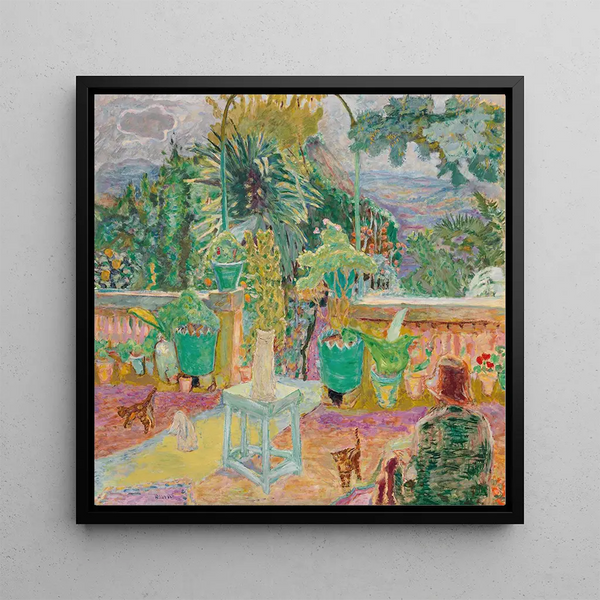
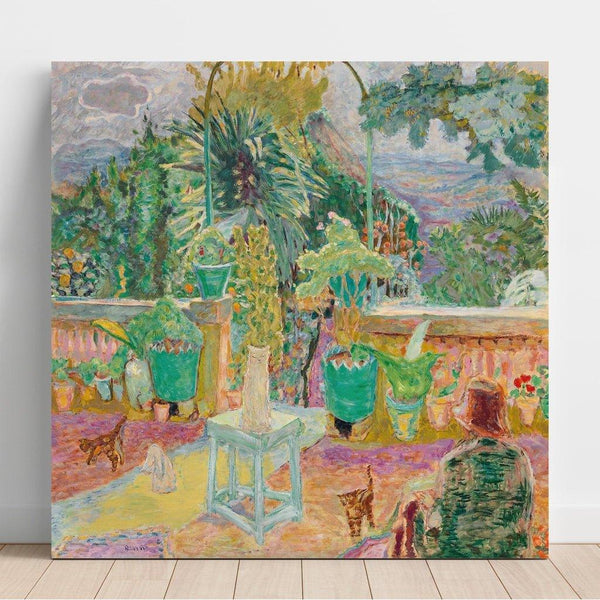
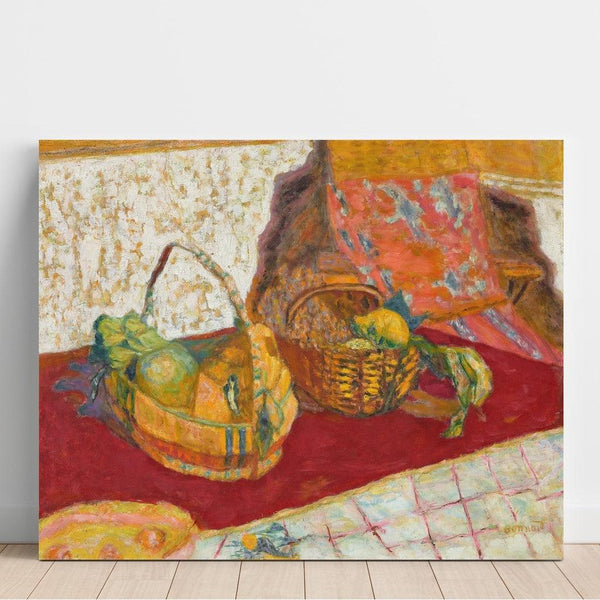
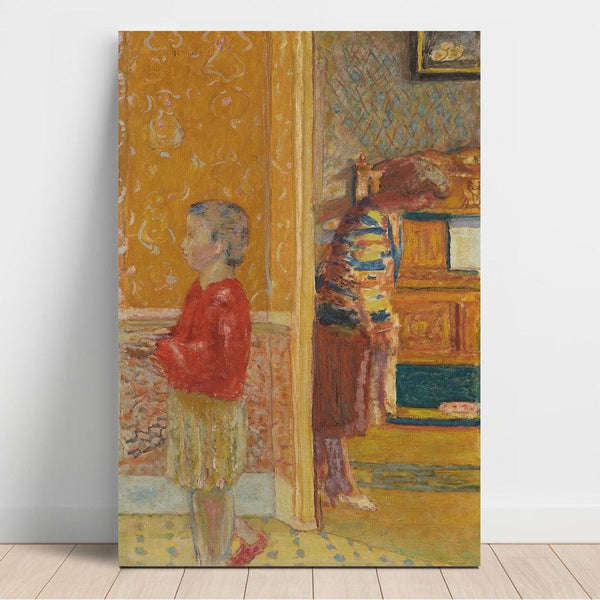
A major figure of French painting from the late nineteenth century and the first half of the twentieth, Pierre Bonnard holds a singular place between the Impressionist heritage and the boldness of modern art. An outstanding colourist and a member of the Nabis group, he devoted his work to light, colour and everyday life, transforming the most intimate scenes into compositions of great chromatic richness. Long debated by critics, his art now stands as one of the most original and free of its time, at once deeply rooted in the real and turned towards the autonomy of colour.
A path between law and painting
Born on 3 October 1867 in Fontenay-aux-Roses, into a cultivated bourgeois family, Pierre Bonnard first studied law before devoting himself fully to painting. This dual training reflects an environment where art was not immediately envisaged as a career, but where culture and drawing held a natural place from childhood onward.
He attended the Académie Julian and then the École des Beaux-Arts in Paris, where he met several young artists destined to matter lastingly in his life. It was during these formative years that he asserted a taste for the supple line and the flat plane of colour, nourished by the print and by the emerging poster. In 1891, his poster France-Champagne brought him recognition and already illustrated his sense of arabesque and decorative composition, a success that did not escape Toulouse-Lautrec.

These early successes steered Bonnard towards an art in which easel painting engages in dialogue with the graphic arts. Far from separating the genres, he conceived of his work very early on as a continuous exploration of the relationships between form, colour and space, a concern that would never leave him.
Bonnard and the Nabi adventure
At the turn of the 1890s, Bonnard joined the Nabis group, alongside Maurice Denis, Édouard Vuillard, Paul Sérusier and Ker-Xavier Roussel. Inspired by Gauguin's example and by the synthesis of forms, these young painters sought to move beyond mere imitation of nature in order to favour colour, rhythm and the decorative dimension of the work. The very term "nabi", borrowed from Hebrew, designates the "prophets" of a renewed art.

A passionate admirer of Japanese prints, Bonnard was nicknamed by his comrades the "very Japanese Nabi", owing to the influence of Japonisme on his art: unexpected framing, flat planes of colour, arabesques and compressed spaces. During this period he did not confine himself to canvas but explored lithography, illustration, folding screens and the decorative arts, in a spirit of breaking down the barriers between disciplines that was characteristic of the movement.
With Vuillard in particular, Bonnard is associated with Intimism, that painting attentive to interiors, ordinary gestures and the hushed atmosphere of homes. This attention to daily life, which might have seemed modest, became for him the starting point of an ambitious pictorial inquiry, in which the apparent banality of a scene takes on an unexpected visual intensity.
Colour, light and everyday life
Bonnard's work draws tirelessly on the closest reality: interiors, laid tables, gardens, open windows and familiar figures. He rarely painted from nature, preferring to work from memory, drawing on notes and sketches, in order to render not the exact appearance of a scene but the coloured sensation it had left in him. This method explains the freedom of his compositions, in which perception prevails over description.

The figure of Marthe, his lifelong companion whom he married in 1925, runs throughout his work, notably in the long series of bathers and nudes in the interior. These canvases, in which water, tiling and light seem to dissolve into coloured vibrations, rank among his most admired and most discussed achievements, so fully do they reconcile the intimacy of the motif with the boldness of the brushwork.
From the 1920s onward, Bonnard stayed frequently in the South of France and settled in Le Cannet, in a villa he named "Le Bosquet". The Mediterranean light intensified his palette there: yellows, oranges, mauves and greens unfold with growing freedom. The floral still lifes, such as those found in reproductions like Renoncules au Vase Bleu, extend this pursuit of a fully autonomous colour, in which the bouquet becomes a pretext for a chromatic harmony.
The art market, portraits and posterity

Supported by influential dealers, among them the Bernheim-Jeune gallery and Ambroise Vollard, Bonnard enjoyed recognition fairly early, which secured him a relative independence. Vollard, a passionate dealer and publisher, commissioned ambitious illustrated books from him and was also the model for a famous portrait, in which the painter captures the massive, pensive presence of this great figure of the art market. These ties recall the decisive role that galleries played in the diffusion of modern art.
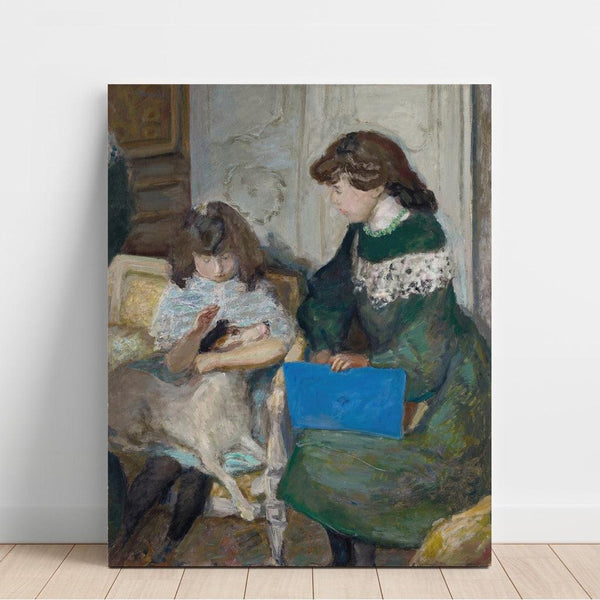
A sensitive portraitist and an attentive observer of people as of animals, Bonnard produced many scenes of figures in their familiar setting. Works such as La Femme au Chien, now offered as a reproduction, illustrate this taste for domestic intimacy, in which the presence of an animal fully contributes to the balance of the composition and to its warmth.
Having died on 23 January 1947 in Le Cannet, Pierre Bonnard left behind a considerable body of work, for a time eclipsed by the more theory-driven avant-gardes of the twentieth century before being fully reassessed. His canvases now hang in the great museums, in France as abroad, and continue to inspire through their chromatic boldness and their gentleness. To rediscover Bonnard is to measure how far the painting of everyday life, carried by a sovereign colour, can reach the universal.
Discover the full range of Pierre Bonnard painting reproductions.