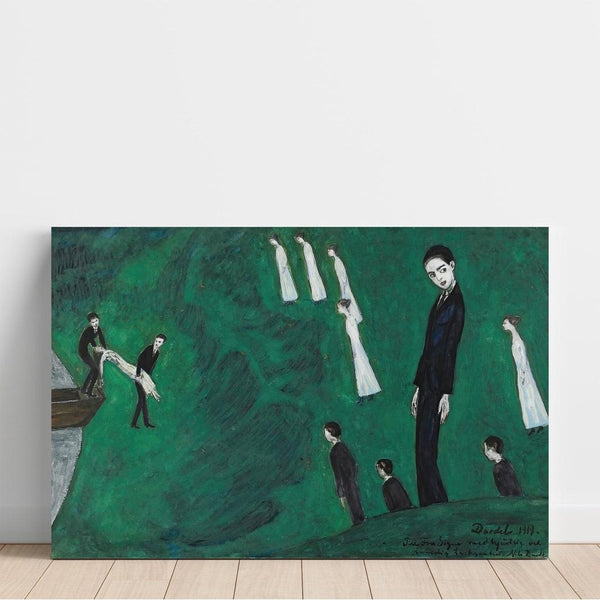
Few painters embody the anxious elegance of the early twentieth century as fully as Nils Dardel. A Swedish artist with a cosmopolitan path, he moved among the Parisian avant-gardes without ever abandoning a deeply personal sensibility, one made of refinement, irony and melancholy. His work, at once decorative and unsettling, occupies a singular place today in the history of Scandinavian modern art. This article offers a sober, documented journey through his life, his training, his style and the paintings that secured his lasting reputation.
A figure of Swedish modernism
Nils Dardel was born in 1888 in Bettna, in the Södermanland region, into a family of the Swedish nobility; his full name, Nils von Dardel, recalls those origins. Drawn early to drawing and painting, he turned toward an artistic career at a moment when Sweden, long remaining on the margins of Europe's great creative centres, was gradually opening to ideas coming from the continent. His trajectory thus mirrors the transformations of a generation seeking to reconcile Nordic heritage with international modernity.
His life would be marked by a constant back-and-forth between Scandinavia and abroad, and by a pronounced taste for distant travels. This nomadic existence, punctuated by long stays in Paris, nourished a body of work in which exotic atmospheres, worldly scenes and a muted unease come to the surface. Dardel died in 1943 in New York, far from his native land, as if to close a biography placed under the sign of displacement and elsewhere. He is regarded today as one of the most original Swedish artists of the first half of the twentieth century.

From Stockholm to Paris: the shaping of a style
Nils Dardel's training began at the Royal Academy of Arts in Stockholm, where he acquired the academic foundations of the craft. But it was his move to Paris, around the 1910s, that proved decisive. The French capital was then the epicentre of the most daring pictorial research, and the young painter discovered there first-hand the changes that were overturning representation: the lesson of Cézanne, the rise of Cubism, the chromatic boldness inherited from Fauvism, as well as the persistent influence of the Japanese print on line and composition.
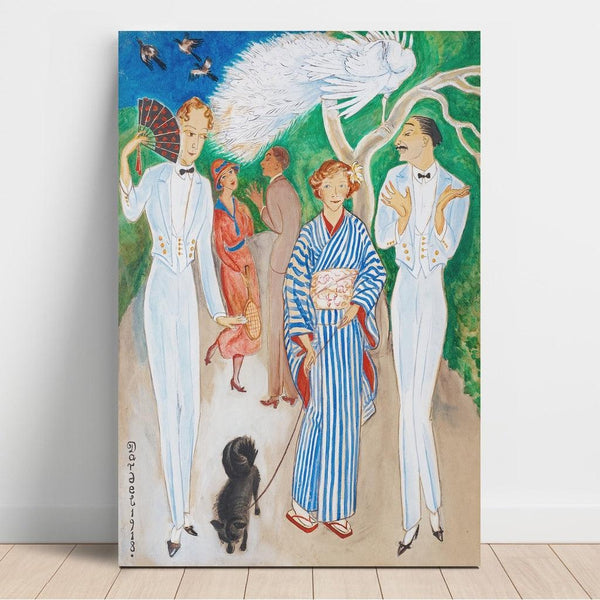
Dardel did not merely absorb these influences; he filtered them through a sensibility that favoured the elegance of line, the clarity of colour and a controlled theatricality. Rather than yielding to abstraction or radical fragmentation, he kept the human figure and narrative at the heart of his painting. His compositions, often legible and carefully arranged, convey an art of refinement that owes as much to the avant-gardes as to an older visual culture, that of miniatures, genre scenes and the decorative tradition.

The Parisian milieu also offered him a fertile network of artistic sociability. Dardel moved among the cosmopolitan circles where painters, writers and discerning connoisseurs crossed paths, and formed a close bond in particular with the collector and patron Rolf de Maré, whose name remains associated with the adventure of the Ballets Suédois. These acquaintances reinforced his interest in spectacle, staging and elegant artifice, dimensions that reappear transposed in his painting.
The Dying Dandy and the art of intimate drama
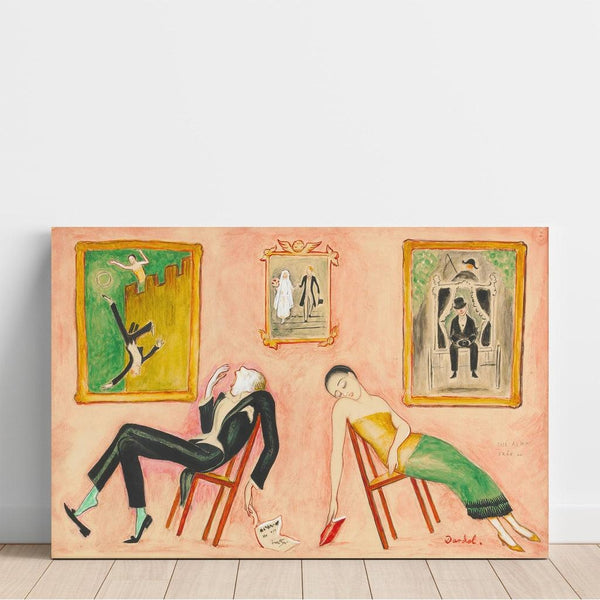
If one were to keep only a single work by Nils Dardel, it would no doubt be The Dying Dandy, painted in 1918 and held at the Moderna Museet in Stockholm. The painting stages a refined young man, collapsed, surrounded by elegant figures whose attitudes waver between compassion and detachment. The composition, with its vivid colours and crisp handling, transforms a moment of distress into an almost choreographed tableau, where the drama is dressed in the trappings of beauty. This tension between formal lightness and the gravity of the subject sums up Dardel's art.
In it one reads a reflection on the figure of the dandy, that ideal of elegance and ironic distance running through the literature and arts of the late nineteenth and early twentieth centuries. The painter seems both to celebrate and to question this posture, showing the fragility hidden behind the controlled appearance. The work has lastingly fixed the image that posterity retains of the artist: that of a creator of melancholy refinement, attentive to social role-playing and to its share of vanity.
This vein of the worldly, convivial scene appears elsewhere in his work, notably in a painting such as Lilla Julaftonsklubben, whose title evokes a circle of festive sociability. Here again, Dardel observes the rituals of social life with a mixture of affection and distance, capturing the faces and gestures of an elegant world he knows from within. His group compositions display a keen sense of the arrangement of figures and an ability to hold, within a single frame, social observation and decorative invention.
Travels, melancholy and legacy

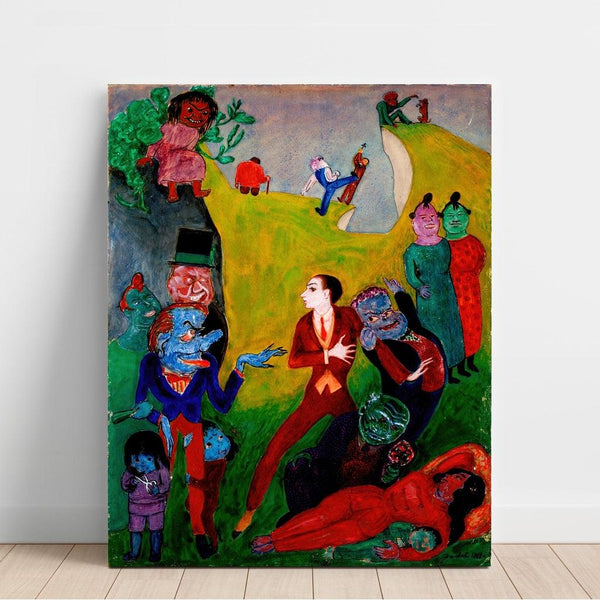
Nils Dardel's taste for distant horizons permeates a significant part of his work. A great traveller, he brought back from his journeys impressions that translated into colourful scenes, dislocating atmospheres and motifs borrowed from cultures far from his own. This dimension of travel, essential to his biography, gives his painting a tone of escape, tempered by a persistent melancholy that prevents any purely picturesque reading. In him, the change of scene is often accompanied by a feeling of solitude and passage.
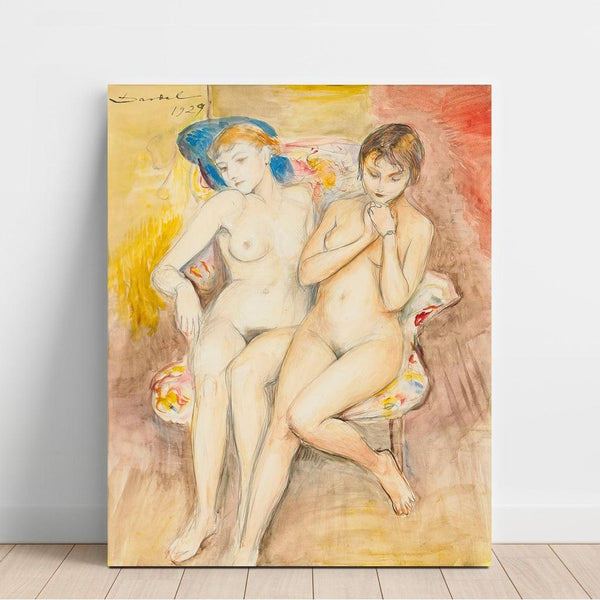
His style, recognisable among all, combines a bright, tart palette, a supple line and a hushed theatricality. This visual signature explains the loyalty that enthusiasts and collectors continue to show him. Several of his compositions are thus appreciated in reproduction, such as Young Man in Black, Girl in White, whose chromatic contrast sums up his sense of refinement, or The Trans-Siberian Express, which points directly to his passion for travel and long journeys. These reproductions make it possible to bring into daily life a pictorial world where elegance vies with strangeness.
Today, Nils Dardel's legacy is measured by the place he occupies in Swedish public collections and by the renewed interest of critics in an art that long remained at the edge of the great narratives of modernity. Neither fully Cubist nor Surrealist in the strict sense, he eludes classification and asserts a singular voice, that of a painter of anxious refinement. To rediscover his work is to recover a modernity on a human scale, alert to faces, costumes and atmospheres, and shot through from end to end with an elegant gravity.
Discover the full range of Nils Dardel painting reproductions.