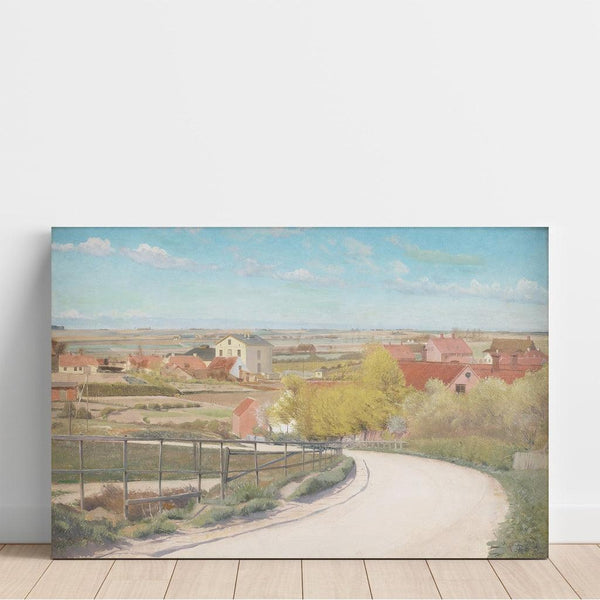
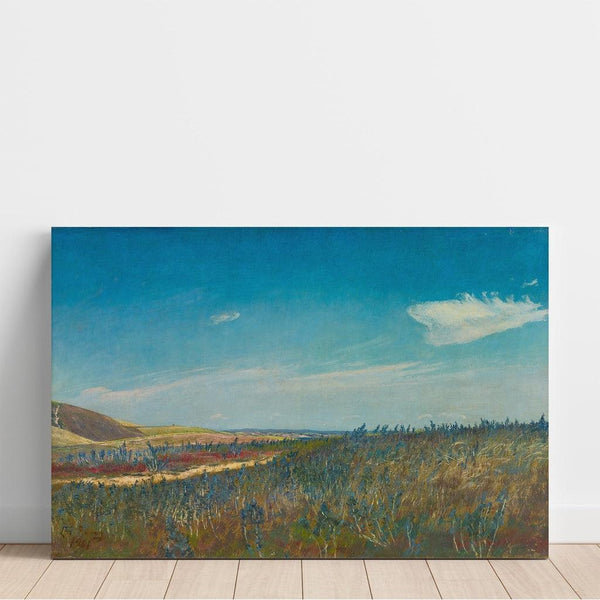
A leading figure of Danish painting at the turn of the twentieth century, Laurits Andersen Ring (1854-1933) holds a singular place between rural realism and emerging symbolism. Attentive both to the humble life of the Zealand countryside and to the inner anxieties of his time, he left behind a highly coherent body of work, made of silent landscapes, solitary figures and a keen sense of atmosphere. This feature offers a sober journey through his life, his manner and a few of his works, several of which are available today in reproduction.
A life rooted in the Danish countryside
Laurits Andersen was born in 1854 in the village of Ring, in the south of the island of Zealand, Denmark. It is from this birthplace that he took the name under which he would sign his canvases, adopting "Ring" to set himself apart and to bind himself symbolically to the land where he grew up. Coming from a modest artisan background, he knew at first hand the rural world that would become the heart of his subject matter. This closeness, never disowned, nourished throughout his career a painting deeply tied to the landscapes, the labours and the seasons of the Danish provinces.
His training at the Royal Danish Academy of Fine Arts in Copenhagen gave him a solid technical command without drawing him away from his roots. Ring trained at a time when Danish painting was seeking to renew its language, between the heritage of the national Golden Age and the currents coming from Europe. In 1896, his marriage marked an important personal milestone and coincided with a period in which his work flourished, as the themes of domestic intimacy and family life grew in presence. He continued working until the last years of his life and died in 1933.

Between rural realism and symbolism
Ring's art is best understood at the meeting point of two sensibilities. On the one hand, a precise realism born of direct observation: he painted country lanes, low houses, fields and peasant figures caught in their daily lives, with a concern for detail and social truth. On the other, a symbolist inclination that charges these ordinary scenes with a graver resonance. In his hands, a road receding into the distance, a window, a figure seen from behind or a winter sky becomes the vehicle for a quiet meditation on time, solitude and passing.
This dual allegiance makes Ring one of the chief introducers of symbolism into Danish painting, without his abandoning the concrete grounding of the real. His palette, often restrained, favours muted tones and frontal or wintry light, conducive to a contained emotion. His carefully constructed compositions leave room for broad spaces and perspectives that invite the eye to linger. The result is a painting sober in appearance yet inhabited by an inner intensity that sets it apart from mere documentation.

Like many artists of his generation, Ring also travelled through Europe, notably to Italy, where he discovered other landscapes and other motifs. These stays broadened his repertoire and fed his reflection on universal themes, among them mortality, without ever lastingly detaching him from his attachment to the Danish world.
A look at a few works
Several paintings offer a way into Ring's world. Winter scene illustrates his taste for the cold season, where snow and low light simplify the landscape and heighten the silence of the countryside. In this kind of composition, winter is not merely a backdrop: it becomes a way of paring down the scene and making one feel both the harshness and the austere beauty of rural life. Christmas visit shifts the gaze towards the intimacy and social life of the villages, linking the Christmas season with an attention to human gestures and relationships, in the vein of the genre scenes he was fond of.

The painting At Breakfast, offered here in reproduction, belongs to this family of images devoted to the domestic interior and to everyday life. In it Ring treats the light of day, the presence of objects and the calm of an ordinary moment with an acuity that turns the mundane into a subject worthy of painting. This kind of scene, often bathed in a soft clarity, reveals his art of suggesting the atmosphere of a home and the weight of time passing peacefully.
In contrast to this reassuring intimacy, Three Skulls from the Capuchin Convent in Palermo, also available in reproduction, testifies to a graver strain, born of his travels in Italy. The motif refers to the famous Capuchin catacombs of Palermo and belongs to a long tradition of the vanitas and the memento mori. Here Ring confronts the viewer with the presence of death with a controlled frontality, showing that his symbolism could also face directly the great questions of existence.
A lasting place in Danish art

The work of Laurits Andersen Ring today holds a recognised position in the history of Danish art of the late nineteenth and early twentieth centuries. By combining a faithful observation of the countryside with a symbolist sensibility, he helped renew the way landscape and genre scenes were regarded, opening the way to a painting able to speak of both the real and the invisible. His formal rigour and expressive restraint make him an artist whose modernity owes less to rupture than to depth.
For the art lover as for the collector, Ring offers a privileged access to a Nordic aesthetic in which apparent simplicity conceals a great richness of meaning. His winter landscapes, his interiors and his more symbolic compositions continue to speak to the contemporary viewer, alive to their mood of contemplation. Reproductions of his works allow this encounter to be prolonged and set, within an interior, a fragment of this Danish art at once discreet and powerfully evocative.
Discover the full range of reproductions of paintings by Laurits Andersen Ring.