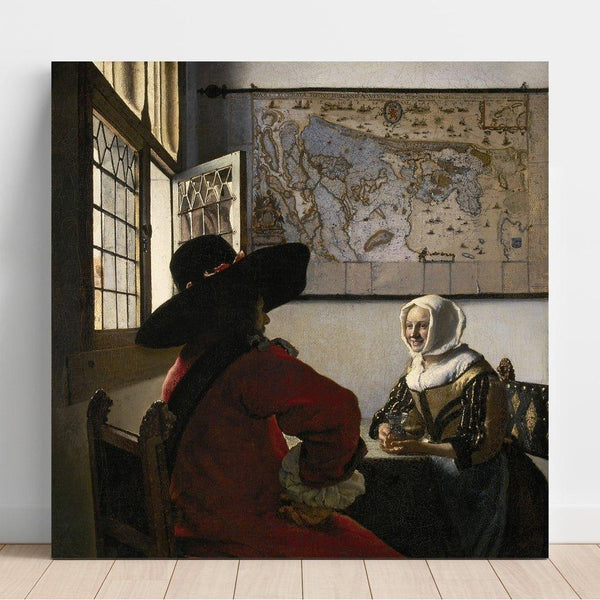
Few artists inspire a fascination as enduring as Johannes Vermeer. A painter of the Dutch Golden Age, he built a small body of work of rare intensity, entirely devoted to light and to the silence of interiors. Long left in obscurity after his death, he now holds a central place in the history of Western painting. This article offers a measured perspective on his life, his major paintings and the principles that make his art so singular, in order to better understand why his name still resonates with enthusiasts and institutions alike.
A quiet life in Delft
Johannes Vermeer was born in Delft in 1632, into a family connected with commerce and the sale of works of art. The town, prosperous and refined, formed the setting for nearly his entire existence. Little documentation survives about his training, which leaves many grey areas around his early years and his possible masters. This scarcity of sources contributes to the enigmatic character attached to his figure.
In 1653, Vermeer was admitted to the Guild of Saint Luke in Delft, the corporation that brought together the town's painters and craftsmen. He would later hold positions of responsibility there, a sign of clear local recognition. His family life was marked by numerous children and by recurring material difficulties, aggravated by an unfavourable economic climate in the final years of his life. He died in Delft in 1675, leaving his family in a precarious financial situation.

After his death, his work went through a long eclipse. The limited number of paintings he produced, scattered across private collections, contributed to his relative obscurity for nearly two centuries. It was only in the nineteenth century that he was truly rediscovered, notably thanks to the French critic Théophile Thoré-Bürger, whose research drew attention to this master who had remained little known. Since then, the reappraisal of his work has continued to deepen.
Masterpieces of rare intensity
Vermeer's catalogue consists of a limited number of canvases, which makes each of them precious. Among his most admired achievements is the View of Delft, a panorama of his native town captured under shifting light, where the façades, the sky and the water form a balance of remarkable precision. This urban landscape reflects an attentive observation of atmosphere and an unusual command of the play of reflections. It is today one of the most famous paintings associated with the painter's name, and lends itself admirably to a reproduction intended to adorn a contemporary interior.

Alongside his interior scenes, Vermeer also took on subjects that are rarer in his work. Diana and her Companions, an early painting of mythological inspiration, shows an artist still close to the great narratives, before he concentrated his attention on domestic life. The Geographer, a later work, depicts a man absorbed in his work, bent over his instruments in the light coming from the window. This studious figure illustrates the period's interest in science and exploration, while retaining the restraint characteristic of the artist.
His portraits of female figures are also among his most appreciated achievements. Woman with a Pearl Necklace offers an accomplished example: a woman caught in an intimate gesture, bathed in a soft light that reveals the texture of the fabrics and the discreet glow of the pearls. This kind of image, in which anecdote gives way to the suspended moment, sums up the spirit of his art and naturally ranks among the most sought-after reproductions.
Style and the mastery of light
What sets Johannes Vermeer apart is, above all, his way of handling light. In his interiors, the light most often enters through a side window and comes to model faces, walls and objects with extreme delicacy. This light is never spectacular: it envelops the scene, unifies the surfaces and establishes an atmosphere of contemplative calm. The viewer has the sense of witnessing an ordinary moment, yet one raised to the dignity of a meditation.

His palette, sober and harmonious, gives a particular place to blues and yellows, combined with nuanced whites and subtle shadows. Vermeer takes care over the rendering of materials, whether satin, faience or pale walls, and composes his paintings with a discreet geometric rigour. The objects are few, arranged with restraint, so that nothing disturbs the overall balance. This economy of means fully contributes to the power of his images.
The question of the technical methods used by Vermeer has long fuelled discussion among art historians. Some have raised the possible use of an optical device such as the camera obscura, which may have helped him to observe effects of light and perspective. In the absence of documentary certainty, this hypothesis remains debated. It nonetheless testifies to the exceptional attention the painter paid to visual phenomena and to the modernity of his vision.
A legacy still alive

Vermeer's late recognition has only amplified the aura surrounding his name. The small number of works attributed to him, kept for the most part in major museums, reinforces their exceptional character and the attention visitors give them. Every exhibition devoted to the painter becomes an event, drawing large crowds who come to contemplate these intimate scenes in which time seems to stand still.
Vermeer's influence extends well beyond the seventeenth century. His way of composing space and handling light has nourished the reflection of many artists and continues to inspire photographers and filmmakers attentive to the quality of lighting. Beyond specialist circles, his images have become shared references, familiar to a very broad public, precisely because they combine apparent simplicity with depth.
For today's enthusiast, surrounding oneself with a faithful reproduction of the View of Delft or of the Woman with a Pearl Necklace means bringing a fragment of this history into one's home. It is also an invitation to return regularly to the work of the master of Delft, whose sobriety and luminous intelligence retain, several centuries after their creation, a remarkable power of evocation.
Discover the full range of Johannes Vermeer painting reproductions.