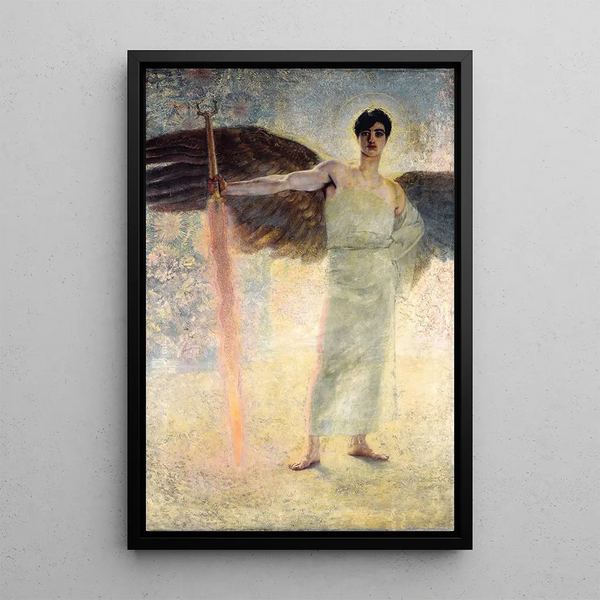
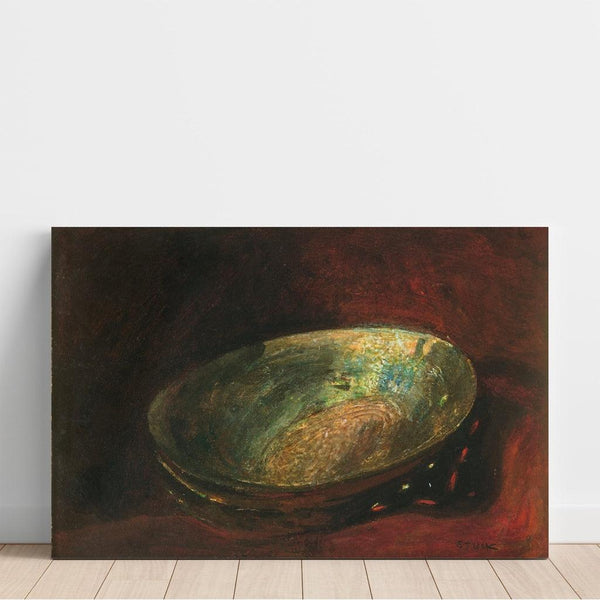
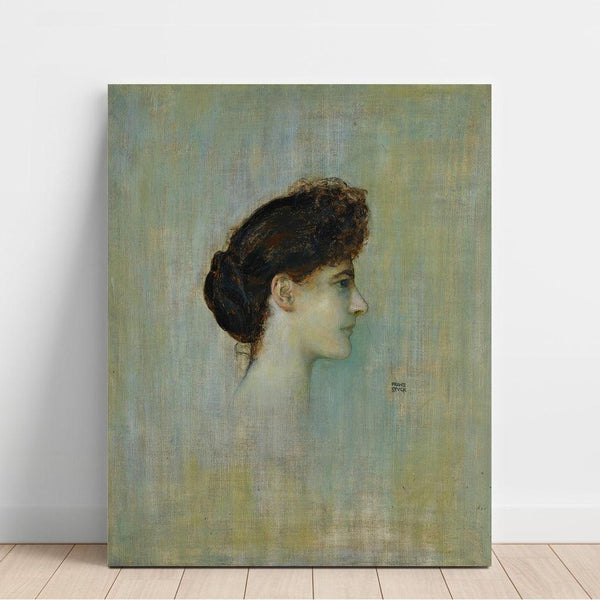
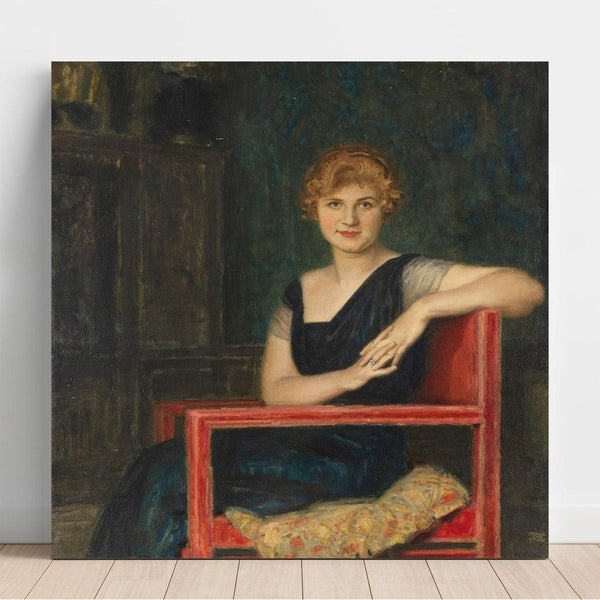
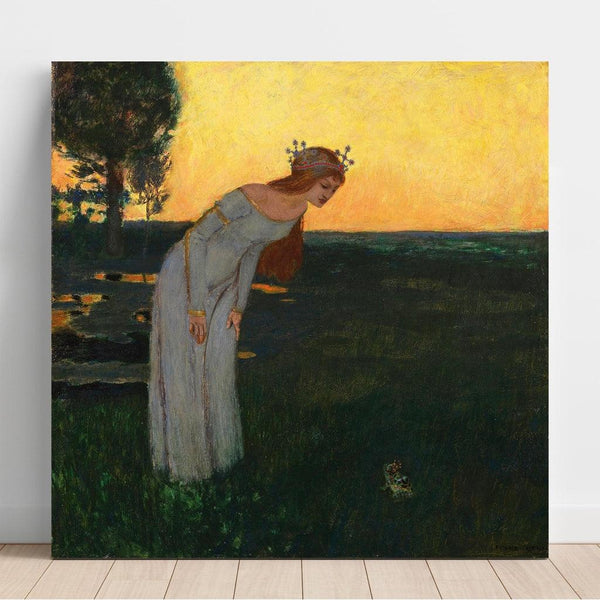
Few figures embody the transition from the nineteenth to the twentieth century in Germany as fully as Franz von Stuck (1863-1928). A painter, sculptor, engraver and architect, he was one of the most celebrated personalities of Belle Époque Munich, where he was readily nicknamed the "prince of painters." His work, at the crossroads of Symbolism and Jugendstil, blends ancient mythology, sensuality and gravity in a style of immediately recognisable power. Rediscovered over the course of the twentieth century, he now holds a firm place in the history of European art.
From Lower Bavaria to the heights of Munich
Franz Stuck was born in 1863 in Tettenweis, a village in Lower Bavaria, into a modest family: his father was a miller. Gifted at drawing, he made his way to Munich, where he trained, notably at the Academy of Fine Arts, and first became known through illustrations, caricatures and decorative motifs. This ornamental work, executed with great graphic virtuosity, would leave a lasting mark on his painting, attentive to the frame, the line and the decorative balance of the composition.
Recognition came in the late 1880s and early 1890s. In 1892, he was among the founders of the Munich Secession, a movement that brought together artists eager to break free from official academicism and to assert a freer sensibility. His career then rose rapidly: awards, commissions and international renown followed one after another. In 1906 he was ennobled, which earned him the particle "von" and the title of Ritter von Stuck, a rare social distinction for a painter from such humble origins.

A Symbolist imagination
It was with The Sin (Die Sünde), presented in the early 1890s, that Stuck established himself for good. The canvas, showing a nude woman half enveloped in shadow and entwined by a serpent, caused both scandal and sensation; it became one of the emblematic images of European Symbolism. Stuck produced several versions of it, a sign of the importance he attached to it and of the success it met with among the public and critics alike.
His repertoire draws abundantly on ancient mythology and fable: fauns, centaurs, nymphs, sphinxes and deities people scenes where desire brushes against menace. Works such as The Seesaw, in which a female figure surrenders to the motion in a woodland setting, or The Wounded Amazon, which treats the martial theme with an almost sculptural intensity, illustrate this oscillation between grace and dramatic tension. The same sense of rhythm and of the body is found in his compositions of dancers, where the supple line of Jugendstil embraces movement.

Stuck's manner is recognisable by its dark, warm tones, by its deep grounds from which sculpturally modelled figures emerge, and by a pronounced taste for staging. Committed to the unity of the painted object, he designed many of his own frames, often gilded and architectural in inspiration, conceived as an extension of the canvas. This search for harmony between the image and its setting reflects a demanding conception of the painting, regarded as a whole controlled down to its smallest details.
The Villa Stuck, a total work of art
Stuck's ambition was not confined to the easel. In Munich, he designed his own residence, the Villa Stuck, completed at the turn of the century. He drew up its architecture, interior layout, furniture and even its decorative elements, creating a true total work of art (Gesamtkunstwerk) in the spirit of the time. Inspired by classical antiquity, the villa asserts the artist's status as much as it provides a sumptuous setting for his creation.

This place, where painting, sculpture and the decorative arts are in constant dialogue, sums up its owner's aesthetic ideal: that of a unified art, refusing the separation of genres. Now a museum devoted to the artist, the Villa Stuck remains today a precious testimony to his vision and an anchoring point for understanding his work.
A master and his legacy
A professor at the Munich Academy of Fine Arts, Stuck exerted a considerable influence over an entire generation. Among his students were artists destined to transform twentieth-century art, notably Wassily Kandinsky, Paul Klee and Josef Albers. This lineage, often emphasised, reminds us that the Symbolist master, reputedly traditional in his subjects, was also an open-minded teacher whose studio welcomed future pioneers of abstraction and modern art.

After his death in 1928, the favour he had enjoyed faded for a time, before a renewed appreciation of Symbolism and Jugendstil fully rehabilitated him. His great mythological compositions are now recognised as landmarks of the art of their era, studied and exhibited once again with care. His ability to combine classical culture and decorative modernity makes him an essential hinge between two centuries.
For enthusiasts, reproductions of works such as The Seesaw or The Wounded Amazon offer the chance to rediscover, in a contemporary interior, the sovereign line and singular atmosphere that made the painter's reputation. They recall the place held by Franz von Stuck in the history of Symbolism, that moment when European painting set out to give form to dream, myth and the dark forces of the imagination.
Explore the full range of Franz von Stuck painting reproductions.