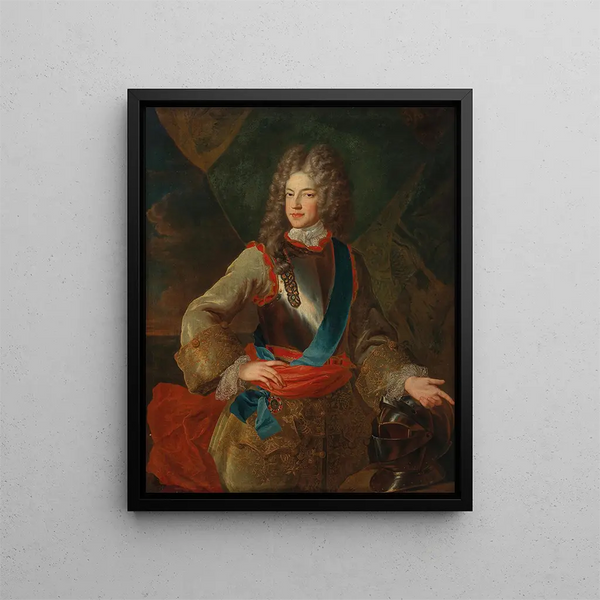
Among the French portraitists of the late reign of Louis XIV and the Regency, Alexis Simon Belle holds a singular place. Active in Paris and Saint-Germain-en-Laye, he was one of the appointed painters of the exiled Stuart court and knew how to give his sitters that presence at once dignified and nuanced which characterises the great ceremonial portrait of his time. His name remains less celebrated today than those of Rigaud or Largillierre, his contemporaries, yet his work bears witness to a sure mastery and to a sensitivity in the rendering of fabrics, complexions and attitudes that fully deserves the attention of connoisseurs. This page sets out to retrace his career and to evoke a few of the works that allow us to rediscover him today.
A portraitist in the wake of the Grand Siècle
Alexis Simon Belle was born in Paris in 1674 and died there in 1734. He belonged to that generation of painters trained in the last decades of the seventeenth century, when the ceremonial portrait enjoyed considerable prestige in France. The son of a painter, Jean-Baptiste Belle, he grew up in a milieu where the craft was passed on and learned through direct contact with the studio. This artisanal lineage, common at the time, doubtless explains the precocity of his training and the technical ease he would display very early on.
Belle trained under François de Troy, one of the great Parisian portraitists of the late reign of Louis XIV, whose studio was an essential centre for portrait painting. From this master he retained a sense of elegant composition, a taste for ample draperies and a constant attention to likeness, without ever sacrificing the worldly bearing of the sitter. In 1703 he was admitted to the Royal Academy of Painting and Sculpture, an institutional consecration that attests to the recognition of his talent by his peers and opened him access to a prestigious clientele.

His activity belongs to a pivotal period, between the solemn classicism of the closing reign of Louis XIV and the more intimate inflections that herald the eighteenth century. Belle knew how to navigate between these sensibilities: his portraits retain the gravity of ceremony while allowing a share of individual truth to be glimpsed in the gaze or the bearing.
The painter of the exiled Stuart court
The posterity of Alexis Simon Belle is intimately bound up with the Stuart court that took refuge in France. After the Glorious Revolution of 1688, which drove James II from the throne of England, the deposed royal family settled at Saint-Germain-en-Laye, where Louis XIV offered them hospitality. Around this Jacobite centre a small society of British and Irish exiles took shape, which, like any court, needed to fix its features for memory and for dynastic propaganda. Belle became one of the most sought-after painters of this circle.

He notably executed portraits of James Francis Edward Stuart (1688-1766), son of James VII and II, known in history as the "Old Pretender" and Jacobite claimant to the thrones of England, Scotland and Ireland. These effigies, of which several versions and replicas circulated, fulfilled a function at once commemorative and political: they sustained the image of a legitimacy maintained and recalled, throughout Europe, the cause of a dynasty deprived of its kingdom. The portrait thus became an instrument of loyalty, distributed among the supporters who remained faithful to the House of Stuart.
This role as portraitist of a court in exile lends Belle's work a particular historical dimension. His canvases do not merely depict faces: they preserve the visual memory of an uprooted community, of a power held in suspense and of a dynastic hope that spanned several generations without ever coming to fruition.
The art of the ceremonial portrait

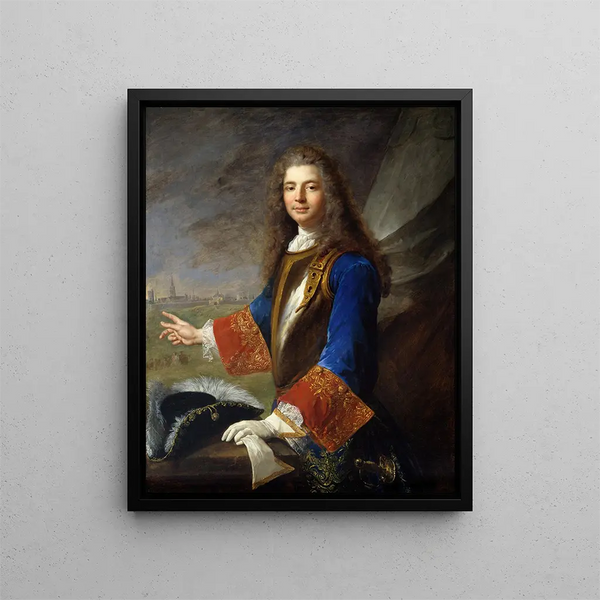
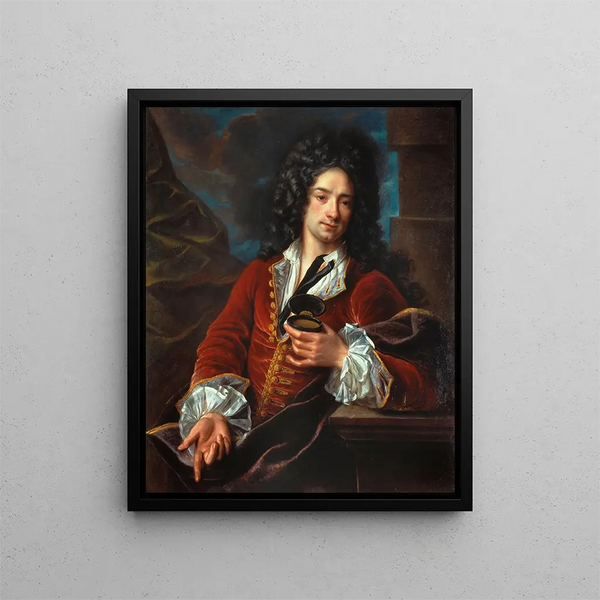
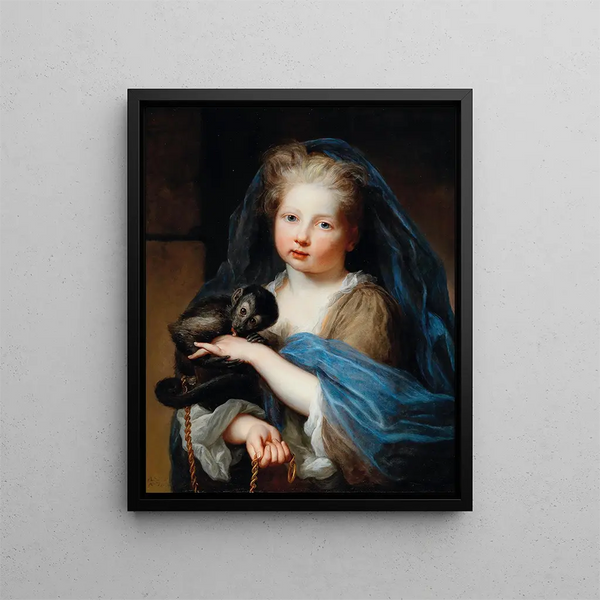
The talent of Alexis Simon Belle unfolds fully in the ceremonial portrait, a genre codified at the time but which left the finest practitioners a real margin of expression. His sitters are captured in measured poses, often in bust or half-length, the face turned towards the viewer or slightly in three-quarter view. The painter takes particular care with the rendering of materials: the silk and velvet of garments, the sheen of embroidery, the softness of complexions. This attention to textures, inherited from the French tradition of portraiture, contributes to the tangible presence of his figures.
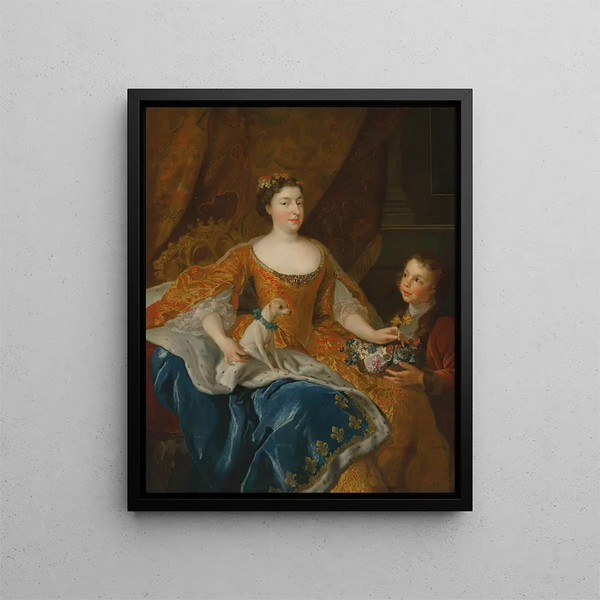
Two works illustrate this manner well and are today offered in reproduction. The Portrait of a Man Seated Wearing a Red Coat and Holding a Letter shows the painter's sense of staging: the deep red of the coat structures the composition and draws the eye, while the letter held in hand introduces a discreet narrative detail, suggesting the sitter's office, his correspondence or his responsibilities. This motif of the held object, frequent in the portraiture of the period, made it possible to individualise the sitter and to evoke his station or his concerns.
The Portrait of a Lady, for its part, bears witness to the finesse with which Belle approached the female portrait. Here, the emphasis readily falls on the elegance of the attire, the grace of the bearing and the delicacy of the modelling. These two paintings, complementary, give an accurate idea of the balance the painter sought between the dignity of the representation and the attention paid to the singularity of each face.

Rediscovering Alexis Simon Belle today
Long remaining in the shadow of more famous portraitists, Alexis Simon Belle today enjoys a renewed interest, carried by the fresh attention given to the history of the Jacobite court and to the circulation of images of power at the turn of the seventeenth and eighteenth centuries. His portraits are held in several public collections, where they stand alongside those of the great names of his era and allow us to gauge the vitality of the French school of portraiture.
For the art lover as for the historian, Belle's work offers a twofold interest: aesthetic, through the quality of the execution and the elegant sobriety of the compositions; documentary, through the testimony it brings on a society of exiles and on the uses of the portrait in court culture. Reproductions of his paintings make it possible to bring this share of history and refinement into one's home, and to prolong, on the walls of a contemporary interior, the memory of an art of portraiture too rarely evoked today. To rediscover Alexis Simon Belle is thus to recover one of the discreet but essential links in the great French tradition of portraiture.
Discover the full range of Alexis Simon Belle painting reproductions.